

Introduction: Navigating the Competitive Path to GUSOM
The Georgetown University Medical School Interview is a pivotal moment in the rigorous and competitive journey to becoming a physician. For aspiring doctors aiming for Georgetown University School of Medicine (GUSOM), understanding the interview process is paramount. This comprehensive guide delves into what you can expect during your Georgetown interview, how to prepare effectively, and how to showcase your alignment with the university’s unique values. Navigating the path to GUSOM involves meticulous planning, deep self-reflection, and a genuine understanding of what the institution seeks in its future physicians.
Georgetown University Medical School Interview Tips
Pre-Interview Guidance
The Georgetown University School of Medicine (GUSOM) is grounded in the Jesuit principle of cura personalis—care for the whole person. This philosophy guides Georgetown’s approach to medicine, emphasizing compassion, reflection, and service to others. As you prepare for your interview, remember that Georgetown seeks students who are not only academically strong but also socially conscious and emotionally intelligent.
Your interview at Georgetown will be traditional and conversational, typically conducted by faculty, alumni, or administrators who are deeply committed to the school’s mission. Expect questions that explore your motivation for medicine, your alignment with cura personalis, and how you plan to use your medical education to serve both individuals and communities.
Georgetown Medical School Interview Tip #1: Show Your Understanding of “Cura Personalis”
Georgetown’s mission revolves around cura personalis, or care for the whole person—mind, body, and spirit. In your interview, convey that you see patients as more than diagnoses. The admissions committee looks for candidates who value empathy, service, and holistic care.
Example: You might say, “While volunteering at a community clinic, I learned that addressing social and emotional needs was just as critical as treating medical conditions. That experience taught me the importance of cura personalis, which is why Georgetown’s mission deeply resonates with me.”
Georgetown Medical School Interview Tip #2: Articulate a Strong “Why Georgetown” Story
Your interviewers want to know why Georgetown is the right fit for you—and why you’re a good fit for Georgetown. Frame your answer as a blend of why medicine, why Georgetown, and who you are. Reference Georgetown’s community-driven education, Jesuit tradition, and opportunities in Washington D.C. for advocacy and public policy engagement.
Example: “I’m drawn to Georgetown because of its integration of ethics, policy, and service. Studying medicine in Washington D.C. will allow me to work with advocacy organizations that focus on healthcare access, aligning perfectly with my goal of improving public health through policy.”
Georgetown Medical School Interview Tip #3: Demonstrate Compassion Through Your Stories
At Georgetown, compassion isn’t a buzzword—it’s a defining trait. The admissions team looks for applicants who have consistently demonstrated care for others. Highlight experiences that reveal empathy, active listening, and commitment to underserved populations.
Example: “During my time as a patient advocate, I worked with uninsured individuals to help them navigate medical resources. Witnessing their vulnerability deepened my understanding of systemic barriers, and I hope to continue addressing these disparities at Georgetown through community health initiatives.”
Georgetown Medical School Interview Tip #4: Connect Your Interests to Interdisciplinary Learning
Georgetown offers unique opportunities for collaboration across its graduate schools, including the McDonough School of Business and McCourt School of Public Policy. If your interests extend to business, leadership, or health policy, discuss how these can complement your medical education.
Example: “I’m interested in the intersection of healthcare delivery and economics. The opportunity to take classes at the McDonough School of Business would give me the tools to design sustainable community health programs alongside my clinical training.”
Georgetown Medical School Interview Tip #5: Reflect on Your Broader Experiences and Personal Growth
Georgetown values diversity in all its forms—background, thought, and experience. Use your interview to share personal growth stories, challenges you’ve overcome, or moments that shaped your worldview. Admissions officers want to see humility, reflection, and a lifelong commitment to service.
Example: “As a first-generation college student, balancing work and academics taught me perseverance and gratitude. These experiences shape how I approach patient care—with empathy and an understanding that each person’s story is complex and unique.”
Sample Georgetown University School of Medicine Interview Questions & Themes
- How do you embody the Jesuit value of cura personalis?
Reflect on how you provide compassionate, holistic care—emotionally and ethically, not just clinically. - Why Georgetown, and why now?
Connect Georgetown’s mission, D.C. opportunities, and your personal motivations for pursuing medicine. - Describe a time you advocated for someone in need.
Show initiative and empathy; demonstrate that service is integral to who you are. - How do you see yourself engaging with the Georgetown and D.C. communities?
Mention community clinics, health advocacy work, or policy interests that align with local opportunities. - Tell me about a challenge that shaped your character.
Choose a meaningful story that reveals resilience, maturity, and reflection.
Need Help With Your Georgetown University School of Medicine Interview?
Our team at Cracking Med School Admissions has helped hundreds of applicants succeed in their Georgetown interviews. We’ll guide you in crafting thoughtful responses that highlight cura personalis, service, and fit with Georgetown’s Jesuit mission. Through personalized mock interviews and feedback, we’ll help you deliver authentic, polished answers that stand out.
Contact us today to start preparing for your Georgetown University School of Medicine interview!
Your medical school application Coaches, Mentors, & Cheerleaders
We Personally Advise Every Student We Work With

Rachel Rizal, M.D.
Changing the trajectory of people's lives
Undergraduate
Princeton University
Medical School
Stanford School of Medicine
Residency
Harvard, Emergency Medicine
Awards & Scholarships
Fulbright Scholar
USA Today Academic First Team
Tylenol Scholarship

Rishi Mediratta, M.D., M.Sc., M.A.
Advising students to attend their dream schools
Undergraduate
Johns Hopkins University
Medical School
Stanford School of Medicine
Residency
Stanford, Pediatrics
Awards & Scholarships
Marshall Scholar
Tylenol Scholarship
Global Health Scholar
Each year, the Cracking Med School Admissions team
helps students get accepted to top medical schools.
We can help you get accepted!
Contact us today.
download your interview guide
If you are prepared, the interview gives you the perfect opportunity to standout and shine by sharing with people what you are passionate about.

The Significance of the Interview in a Holistic Review
Medical school admissions committees, including Georgetown’s, employ a holistic review process. This means they evaluate applicants based on a wide range of attributes and experiences, not solely academic metrics. While a strong GPA and MCAT score are foundational, the interview serves as a critical juncture where the admissions committee assesses your personality, character, motivations, and suitability for the medical profession and for Georgetown specifically. It’s your opportunity to transcend the data on your AMCAS applications and demonstrate the qualities that cannot be captured on paper. For the class of 2028, Georgetown Medical School’s acceptance rate stood at a competitive 2.89% Shemmassian Academic Consulting, underscoring the necessity of a standout interview performance.
What This Guide Will Cover
This guide is meticulously designed to equip you, the applicant, with the knowledge and strategies needed to confidently approach your Georgetown Medical School interview. We will explore the distinctive ethos of Georgetown University School of Medicine (GUSOM), dissect the typical interview format, illuminate what interviewers are genuinely seeking, and provide actionable preparation advice for common question types. From understanding the application journey leading up to the invitation to navigating the interview day itself and post-interview follow-up, this resource aims to be your definitive companion.
Understanding Georgetown's Unique Ethos: "Cura Personalis" and Jesuit Tradition
At the heart of Georgetown University’s educational philosophy lies a profound commitment to “cura personalis,” a Latin phrase meaning “care for the whole person.” This principle, deeply rooted in the Jesuit tradition, permeates every aspect of the university, including its medical school. Understanding and embodying this ethos is crucial for any applicant seeking to join the GUSOM community.
Embracing “Cura Personalis”: Care for the Whole Person
“Cura personalis” extends beyond the clinical encounter; it encompasses a commitment to understanding and addressing the multifaceted needs of each individual. In the context of medical school, this translates to recognizing patients not just as a collection of symptoms, but as whole beings with unique social, emotional, and spiritual dimensions. For an applicant, demonstrating “cura personalis” means showcasing empathy, compassion, intellectual curiosity, and a dedication to fostering genuine human connection. It involves reflecting on experiences where you have seen or enacted care for the entire person, and being able to articulate how this principle will guide your future practice as a physician.
The Jesuit Tradition and its Influence on GUSOM’s Mission
Georgetown University, as a Jesuit institution, is dedicated to the pursuit of knowledge and the service of humanity. This rich tradition instills in its students a strong sense of ethical responsibility, a commitment to social justice, and a desire to make a meaningful impact on the world. For GUSOM, this translates into a mission that emphasizes educating physicians who are not only scientifically excellent but also deeply compassionate and committed to serving underserved populations and addressing health disparities. The medical school fosters an environment where intellectual rigor is coupled with moral formation, preparing graduates to lead with integrity and purpose.
Aligning Your Values with Georgetown’s Commitment to Service and Health Justice
Georgetown’s commitment to service and health justice is not merely aspirational; it is woven into the fabric of its Curriculum and clinical experiences. The university actively seeks applicants who demonstrate a genuine passion for addressing systemic inequities in healthcare and a dedication to serving diverse communities, particularly those in urban and underserved settings. When preparing for your interview, reflect on your experiences with community service, advocacy, and your understanding of public health challenges. Articulating how your personal values and experiences align with Georgetown’s mission will powerfully convey your potential to contribute to the School of Medicine‘s goals. This alignment is a key factor interviewers assess to ensure you will thrive within GUSOM’s specific educational and ethical framework.
The Road to Your Interview Invitation
Securing an interview at Georgetown University School of Medicine is a significant achievement, representing a win in a highly competitive applicant pool. Understanding the preceding steps of the application process provides essential context.
From AMCAS to Secondary Application: A Brief Overview
The application journey typically begins with submitting your primary application through the American Medical College Application Service (AMCAS). This comprehensive document includes your academic history, standardized test scores (like the MCAT score), work and experiences, and your personal statement. For the 2023-2024 application cycle, the AMCAS charges an initial fee of $170 for the first school you apply to, with an additional $43 for each extra school Jack Westin. Georgetown, like many other institutions, also requires a Secondary Application. This allows the medical school to gather more specific information tailored to their institution, often including essays that prompt you to elaborate on your motivations and experiences. Georgetown School of Medicine received over 7,000 applications for the most recent admissions cycle Leland, highlighting the intense competition.
Receiving the Interview Email: What to Expect and How to Respond
Once your primary and secondary applications are reviewed, the Georgetown University School of Medicine admissions committee may extend an invitation for an interview. This invitation will typically arrive via email. The email will detail the date and format of your interview (which may be virtual or in-person), provide instructions on how to confirm your attendance, and often include logistical information about the day. It is crucial to respond to this email promptly and professionally, confirming your availability or requesting any necessary accommodations. A prompt and courteous response demonstrates your continued interest and professionalism.
Key Application Deadlines and Their Importance (Brief mention as context)
While not the primary focus of interview preparation, being aware of general application deadlines is important. Early submission of your AMCAS applications and secondary applications is generally advisable, as it allows admissions committees more time to review your materials and increases your chances of receiving an interview invitation earlier in the cycle. While specific interview dates can vary, many take place between January and the spring. Staying organized and mindful of these timelines ensures you do not miss critical opportunities.
Deciphering the Georgetown Medical School Interview Format
The interview day at Georgetown University School of Medicine is structured to provide the admissions committee with a comprehensive understanding of your potential as a future physician and member of their community. While formats can adapt, understanding the common components will help you prepare.
The Typical Interview Day Structure (Virtual Presentation, Individual Interviews)
A traditional interview day at GUSOM often involves a combination of informative sessions and direct interactions with faculty and current medical students. You might participate in a virtual presentation about the School of Medicine‘s mission, Curriculum, and unique programs. This is frequently followed by one or more individual interviews. The exact schedule can vary, but the aim is to provide you with essential information about GUSOM while simultaneously assessing your fit for the institution. If the interview is conducted virtually, be prepared for a structured online environment, ensuring you have a stable internet connection and a quiet, professional setting.
The Traditional Interview Component: Assessing Fit and Personal Qualities
The core of the interview experience typically involves traditional, one-on-one interviews with members of the admissions committee, faculty, or alumni. These conversations are designed to be in-depth discussions about your background, motivations, and aspirations. Interviewers will likely ask questions that probe your understanding of medicine, your experiences in clinical settings, your Research endeavors, and your reasons for choosing Georgetown. This is your chance to articulate your journey, demonstrate your critical thinking skills, and show genuine enthusiasm for GUSOM.
Potential for MMI-Style Questions or Scenarios (Referencing “MMI Question Bank” as a possibility)
While GUSOM primarily utilizes traditional interviews, some medical schools incorporate elements of the Multiple Mini Interview (MMI) format, which uses a series of timed stations to assess various competencies. It is always wise to be prepared for a range of question styles. Familiarizing yourself with common MMI question types, perhaps by exploring resources like an “MMI Question Bank,” can help you practice responding to hypothetical scenarios, ethical dilemmas, and prompts that assess your communication and problem-solving abilities in a standardized format.
Understanding Interview Activities and Their Purpose
Beyond direct questioning, interview days may include other activities designed to assess different facets of your candidacy. This could involve a brief presentation where you discuss a particular experience, or group discussions where your collaborative skills are observed. The purpose of these activities is to gauge how you interact with others, think on your feet, and communicate your ideas effectively in varied contexts. Approach each activity with the same professionalism and thoughtful engagement you would a one-on-one interview.
The Role of the Virtual Interview Format
In recent years, virtual interviews have become increasingly common. While they offer convenience, they also present unique challenges. A virtual interview requires particular attention to technical setup, background presentation, and maintaining engagement through a screen. Ensure your technology is functioning flawlessly, your environment is professional and free of distractions, and your eye contact is maintained as much as possible by looking at the camera. Despite the distance, the goal remains the same: to foster a genuine connection and convey your suitability for Georgetown University School of Medicine.
What Interviewers are Truly Looking For at GUSOM
Georgetown’s interviewers are looking beyond your academic achievements to understand who you are as a person and how you will contribute to their community and the broader medical field. They are assessing qualities that align with the university’s core values and the demands of modern medical practice.
Beyond the Transcript: The Holistic Review in Action
The interview is where the holistic review truly comes alive. Interviewers want to see the individual behind the grades and scores. They are interested in your life experiences, your resilience in the face of challenges, your capacity for growth, and your unique perspective. They are assessing how your background, experiences, and inherent qualities have shaped you into a well-rounded individual prepared for the rigors of medical school and the responsibilities of being a physician.
Demonstrating Professionalism and Ethical Reasoning
Professionalism is a cornerstone of medical practice, and GUSOM places a high value on it. Interviewers will observe your demeanor, communication style, and overall comportment. Be respectful, attentive, and articulate. Ethical reasoning is also paramount. Expect questions that present ethical dilemmas; your ability to thoughtfully analyze these situations, consider different perspectives, and arrive at a reasoned conclusion is crucial. Your responses should reflect a strong moral compass and a commitment to patient well-being.
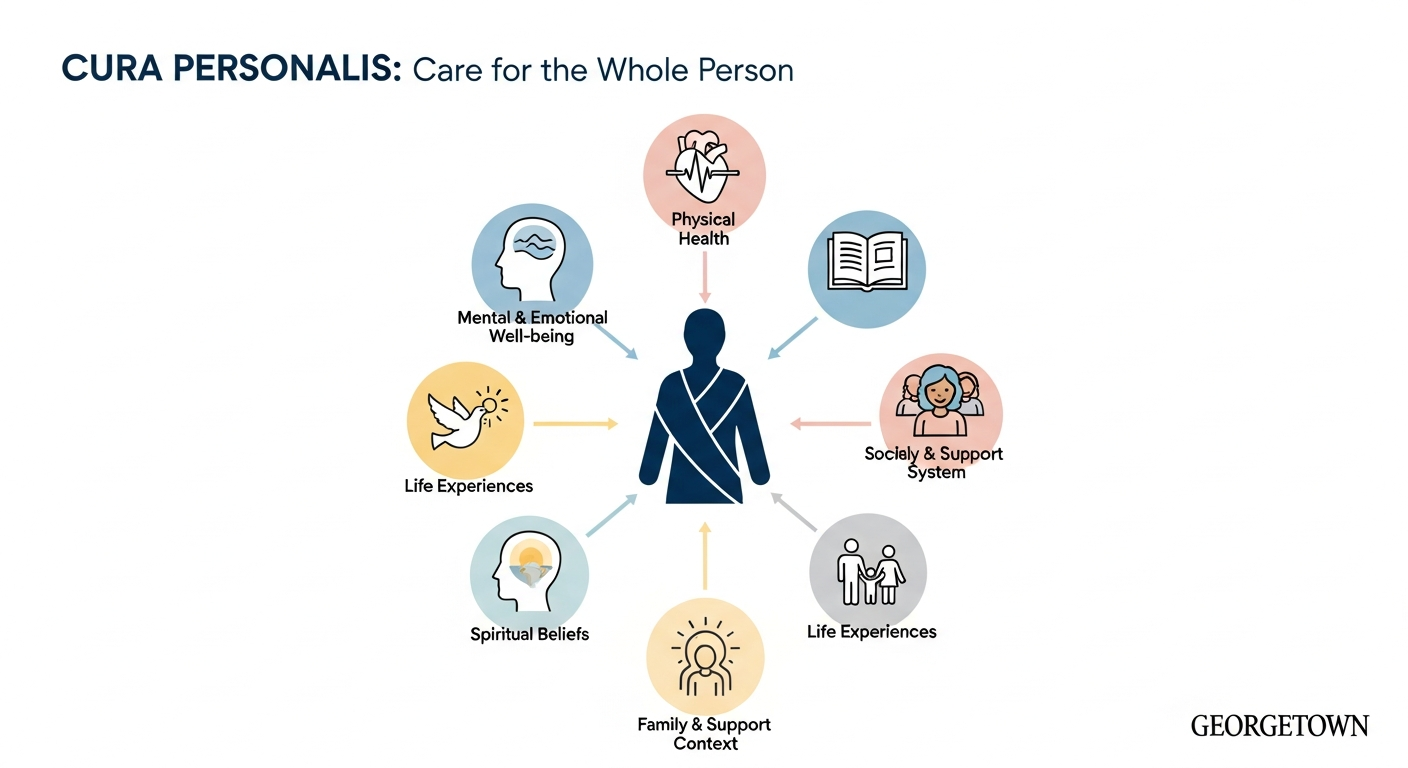
by Cracking Med School Admissions
Georgetown’s principle of ‘cura personalis’ calls for physicians to care for the whole person, considering the interconnected physical, mental, social, and spiritual aspects of a patient’s well-being.
Articulating Your Understanding of “Cura Personalis” in Action
This is a pivotal aspect of the GUSOM interview. It’s not enough to simply define “cura personalis”; you must demonstrate that you understand its practical implications. Think about specific instances where you have shown care for the whole person in your past experiences—whether in clinical settings, volunteer work, or personal relationships. Be prepared to share these anecdotes and explain how they reflect your understanding and embodiment of this Jesuit principle.
Assessing Non-Cognitive Skills: Empathy, Resilience, and Communication
Beyond intellectual prowess, GUSOM seeks applicants who possess strong non-cognitive skills. Empathy, the ability to understand and share the feelings of others, is fundamental to patient care. Resilience, the capacity to bounce back from setbacks, is essential for navigating the challenges of medical school and a demanding career. Effective communication—both listening and speaking—is vital for building rapport with patients, collaborating with colleagues, and conveying complex information. Your interview responses should provide evidence of these qualities.
Identifying Your Alignment with Georgetown’s Mission and Values (e.g., health disparities, urban underserved, public policy)
Interviewers are keen to understand your alignment with Georgetown University School of Medicine‘s specific mission, which often includes a focus on health disparities, serving the urban underserved, and understanding public policy’s impact on health. Reflect on your experiences and motivations that connect with these areas. If you have worked with vulnerable populations, engaged in advocacy, or explored the intersection of policy and health, be prepared to discuss these experiences and articulate why Georgetown’s commitment in these areas resonates with your own aspirations to become a physician.
Preparing for Common Interview Question Types
Effective preparation involves anticipating the types of questions you might encounter and practicing how to respond thoughtfully and authentically.
Behavioral Questions: “Tell Me About a Time When…” (STAR Method)
Behavioral questions are designed to understand how you have handled specific situations in the past, as past behavior is often indicative of future performance. The STAR method (Situation, Task, Action, Result) is an excellent framework for answering these questions. For example, a question like “Tell me about a time you faced a significant challenge” can be effectively answered by describing the situation, your role (task), the actions you took, and the positive outcome or lesson learned. Prepare several examples that highlight your skills in leadership, teamwork, problem-solving, and resilience.
Ethical Scenarios: Navigating Complex Medical Dilemmas
You may be presented with hypothetical ethical scenarios common in healthcare. These questions assess your moral reasoning, critical thinking, and ability to balance competing values. For instance, you might be asked how you would handle a situation where a patient refuses a life-saving treatment. Your response should demonstrate an understanding of patient autonomy, ethical principles in medicine, and the importance of clear communication and empathy, even in difficult circumstances. It’s important to show your thought process rather than just arriving at a definitive answer.
Motivation and Fit: Why Georgetown? Why Medicine?
These are fundamental questions that probe your genuine interest in medicine and your specific reasons for applying to Georgetown University School of Medicine. For “Why Medicine?”, connect your experiences and innate qualities to the core tenets of the profession. For “Why Georgetown?”, go beyond generic praise. Research specific aspects of GUSOM that appeal to you, such as its Curriculum, unique programs (like the Georgetown Experimental Medical Studies, or GEMS, program), faculty expertise, or commitment to specific community initiatives. Demonstrate that you have done your homework and that your decision is well-informed and personalized.
Addressing Your Experiences: Clinical Experiences, Research, Extracurricular Activities
Interviewers will delve into the experiences listed on your AMCAS applications, Secondary Application, and personal statement. Be prepared to discuss your clinical experiences in detail, highlighting what you learned about patient care, the healthcare system, and yourself. If you have Research experience, be ready to discuss your role, the project’s significance, and your findings, even if it’s complex. For extracurricular activities, explain your commitment, the skills you developed, and how these experiences have shaped your perspective and prepared you for medical school.
Discussing Your Personal Statement and Secondary Application Essays
Your personal statement and secondary essays are often a starting point for interview questions. Interviewers may ask you to elaborate on specific points you made, clarify your motivations, or provide further details about an experience you described. Review these documents thoroughly before your interview. Ensure you can speak passionately and articulately about the narratives you presented, and be prepared to expand upon them or address any areas that might have been unclear.
Pre-Interview Preparation: Laying the Groundwork for Success
Thorough preparation is key to feeling confident and performing well during your Georgetown Medical School interview. This involves more than just anticipating questions; it requires a deep understanding of yourself and the institution.
Researching Georgetown’s Curriculum and Initiatives
Dive deep into GUSOM’s offerings. Explore its innovative Curriculum, which often emphasizes early clinical exposure and interdisciplinary learning. Understand the structure of its programs, such as the four-year integrated curriculum designed to foster critical thinking and lifelong learning. Look into specific initiatives related to health justice, urban health, global health, or any Research areas that align with your interests. Familiarity with these aspects will enable you to articulate a compelling “Why Georgetown?” and demonstrate genuine interest.
Understanding the Role of Research and Faculty Interests
Georgetown University School of Medicine has a robust Research enterprise. Familiarize yourself with the key areas of faculty Research and identify any professors whose work aligns with your own scientific interests. If you have Research experience, be prepared to discuss it in detail and connect it to the types of Research conducted at GUSOM. This shows your engagement with the scientific community and your potential to contribute to the institution’s academic endeavors.
Preparing Your “Story” and Key Experiences
Beyond individual experiences, think about the overarching narrative of your journey toward medicine. How have your cumulative experiences shaped your goals and prepared you for medical school? Identify 3-5 key experiences (clinical, research, volunteer, personal) that best exemplify your strengths, values, and suitability for GUSOM. Practice articulating these stories concisely and compellingly, ensuring they align with the university’s ethos.
Crafting Thoughtful Questions for Your Interviewers
An interview is a two-way street. Preparing insightful questions demonstrates your engagement and intellectual curiosity. Avoid questions that can be easily answered by visiting the GUSOM website. Instead, ask questions that delve deeper into the student experience, the impact of “cura personalis” on daily life at GUSOM, or the evolving landscape of medical education and practice. Questions about future directions in Research or specific opportunities for student involvement can also be very effective.
Practicing Mock Interviews
Simulating the interview experience is invaluable. Conduct mock interviews with mentors, advisors, or peers. Practice answering questions aloud, focusing on clarity, conciseness, and delivering authentic responses. Seek feedback on your delivery, content, and overall presentation. This practice will help you refine your answers, manage nerves, and become more comfortable discussing your experiences and motivations.
The Interview Day Experience
On the day of your interview, your preparation will culminate. Maintaining composure, professionalism, and authenticity will be key.
Technical Preparation for Virtual Interviews
If your interview is virtual, ensure all technical aspects are sorted well in advance. Test your internet connection, webcam, and microphone. Familiarize yourself with the platform being used. Choose a quiet space with a neutral, professional background. Dress professionally from the waist up, as you would for an in-person interview.
Professionalism and Etiquette
Treat the entire interview day with the utmost seriousness and professionalism. Arrive (virtually or in person) on time, maintain good eye contact, listen attentively to questions, and answer thoughtfully. Express gratitude for the opportunity and the interviewer’s time. Even during less formal parts of the day, such as interactions with current students, maintain a courteous and engaged demeanor.
Managing Nerves and Maintaining Authenticity
It is natural to feel nervous, but try to channel that energy into enthusiasm. Remember that the interviewers want to get to know you. Be yourself. Authenticity is more compelling than a rehearsed persona. Take a deep breath before answering any question, and if you need a moment to collect your thoughts, it is perfectly acceptable to say, “That’s a great question, let me take a moment to think about that.”
Engaging with Interviewers and Team Members
Be an active participant in the conversation. Show genuine interest in what the interviewers are sharing about Georgetown University School of Medicine. Engage in a dialogue rather than a monologue. If you are interacting with current students or other staff, approach these interactions with the same respect and professionalism you would offer faculty.
Post-Interview: Final Steps and Follow-Up
The interview is a crucial step, but the process doesn’t end when the conversation concludes. Thoughtful follow-up can reinforce your interest and leave a positive final impression.
Crafting a Thank-You Note
Following your interview, send a personalized thank-you note or email to each interviewer, and potentially to the admissions committee or your main point of contact. Reiterate your strong interest in Georgetown University School of Medicine and briefly mention a specific point from your conversation that resonated with you. This reinforces your engagement and leaves a lasting positive impression.
Submitting Updates (If Applicable)
If any significant new experiences or achievements occur after your interview, consider sending a brief update to the admissions office. This could include new Research findings, significant volunteer work, or awards. Ensure updates are concise and relevant, and follow GUSOM’s guidelines for submitting such information. This demonstrates your continued engagement and progress.
Conclusion
The Georgetown Medical School interview is a multifaceted evaluation designed to assess your academic readiness, personal character, and alignment with the university’s distinctive Jesuit values, particularly “cura personalis.” By understanding the institution’s ethos, meticulously preparing for various question types, and approaching the interview day with professionalism and authenticity, you can effectively showcase your potential to thrive at GUSOM and contribute meaningfully to the medical profession. Remember that the interview is an opportunity for mutual discovery—a chance for you to learn more about Georgetown University School of Medicine and for them to understand the unique candidate you are. Your journey from AMCAS applications to interview success is a testament to your dedication, and with diligent preparation, you can confidently present your best self as you aspire to become a future physician.