How to Prepare for Your Case Western & Cleveland Clinic Medical School Interview

The Case Western & Cleveland Clinic Medical School Interview is a monumental achievement. It signifies that your application has risen to the top of an exceptionally competitive pool, and the admissions committee sees the potential for you to become a future leader in medicine. This invitation, however, is not a finish line; it is the start of the most personal and dynamic phase of your application journey. Now, your task is to translate the compelling narrative you crafted on paper into a three-dimensional portrait of a passionate, intelligent, and empathetic future physician.

Contact us if you have questions about your upcoming Case Western & Cleveland Clinic Medical School Interview or if you want to do mock interviews with our team!

Case Western & Cleveland Clinic Medical School Interview Tips

Case Western Pre-Interview Guidance

The Case Western Reserve University School of Medicine and Cleveland Clinic Lerner College of Medicine (CCLCM) are among the most research-driven, innovative programs in the country. Both emphasize academic excellence, leadership in biomedical research, and a commitment to compassionate, patient-centered care.

Case Western uses a traditional interview format, while CCLCM incorporates structured interviews that assess your critical thinking, communication, and motivation for a career in medicine. Regardless of format, your interviewers are looking for candidates who demonstrate curiosity, resilience, and the ability to reflect deeply on personal experiences.

This is your opportunity to show that you not only align with Case Western’s values—but that you are ready to contribute to its mission of advancing medical science and improving human health.

Case Western & Cleveland Clinic Medical School Interview Tip #1: Clearly articulate “Why Case Western & CCLCM”

Both Case Western and the Cleveland Clinic value applicants who are genuinely excited about their programs’ unique learning environments. Avoid vague statements like “I want to attend a research-focused school.” Instead, explain why Case Western’s inquiry-based learning or CCLCM’s research mentorship model fits your long-term goals.

Example: You might say, “I’m drawn to Case Western’s emphasis on self-directed learning and the opportunity to engage in longitudinal research projects. During my undergraduate thesis, I discovered how inquiry and collaboration fuel discovery, and I see those same principles embedded in Case Western’s curriculum.”

Case Western & Cleveland Clinic Medical School Interview Tip #2: Reflect deeply on challenges and growth

Case Western’s secondary essays ask applicants to discuss challenges and how they’ve evolved from them—this theme often appears in interviews as well. Interviewers want to see emotional maturity, insight, and the ability to handle adversity.

When describing a difficult situation, provide enough context, explain how you managed it, and focus on what you learned about yourself. Avoid overly common examples (like getting a “C” in a class) unless they reveal deeper qualities such as perseverance or humility.

Example: If you faced a setback during a research project, you could describe how troubleshooting an unexpected result taught you to approach problems systematically and strengthened your resilience in scientific inquiry.

Case Western & Cleveland Clinic Medical School Interview Tip #3: Be ready to get grilled on your research!

Case Western LOVES research-oriented students. Even if your interviewer doesn’t ask directly, find natural ways to discuss your scientific interests and contributions. 

For the Case Western & Cleveland Clinic Medical School Interview, expect interviewers to deeply probe your research experience, not just at a surface level. At Case Western Reserve University School of Medicine and the Cleveland Clinic, research is tightly integrated with clinical innovation, so interviewers want to see that you truly understand your project’s purpose, methods, limitations, and real-world implications. You should be prepared to clearly explain why the question mattered, how you designed or contributed to the study, what the results actually mean, and where the work could go next. Strong answers demonstrate intellectual ownership, critical thinking, and humility—acknowledging setbacks or unanswered questions—rather than simply listing techniques or publications. This is not about sounding impressive; it is about showing that you can think like a physician-scientist who bridges discovery and patient care.


If you have an upcoming Case Western Medical School interview (whether it’s Case or Cleveland Clinic), be sure to practice with our Cracking Med School Admissions interview team. We will make sure you are PREPARED to get grilled on your research! We get several students into Case Western and Cleveland Clinic each year!

>> Contact us if you have questions. 

Example: Instead of listing techniques, share the impact of your work. You could say, “In my immunology project, I explored how certain cytokines regulate inflammation. The experience taught me how small discoveries can influence larger clinical questions, reinforcing my passion for translational research.”

 
Case Western & Cleveland Clinic Medical School Interview Tip #4: Incorporate “Why Case Western” naturally into your responses

Whenever possible, weave your interest in the school into your answers—especially when asked about your career goals, teamwork, or leadership experiences. Mention specific programs, research centers, or community engagement opportunities that genuinely excite you.

Example: You might say, “I’m eager to participate in the Cleveland Health Challenge because it combines my interest in public health with hands-on collaboration. I see it as a way to bridge my prior work addressing healthcare disparities with Case Western’s community health initiatives.”

Case Western & Cleveland Clinic Medical School Interview Tip #5: Prepare for reflective questions

Given Case Western’s emphasis on integrity, professionalism, and self-awareness, expect scenario-based questions that test your judgment and empathy. Reflect on times when you faced moral or ethical dilemmas—whether in research, clinical settings, or personal life—and be ready to discuss your reasoning process.

Example: If asked, “What would you do if a team member falsified data in a research project?” you could say, “I would first seek to understand the situation privately, emphasizing accountability and transparency. If integrity were compromised, I would escalate the concern through appropriate channels to protect the credibility of our work.”

Sample Case Western & Cleveland Clinic Medical School Interview Questions & Themes
  • Why Case Western or Cleveland Clinic Lerner College of Medicine?
    Be specific—reference aspects like research mentorship, inquiry-based learning, or community engagement.
  • Tell me about a challenge or failure. What did you learn?
    Highlight growth, resilience, and insight rather than the obstacle itself.
  • Describe your most meaningful research experience.
    Focus on your curiosity, problem-solving, and ability to communicate complex ideas clearly.
  • How have you demonstrated empathy or integrity in a difficult situation?
    Show that you prioritize patient welfare, honesty, and professionalism.
  • What role do you see research playing in your future medical career?
    Connect your scientific interests to improving patient outcomes and advancing medicine.
Need Help With Your Case Western or Cleveland Clinic Interview?

Our Cracking Med School Admissions team has helped students earn acceptances to both Case Western and CCLCM through personalized mock interviews and one-on-one coaching. We’ll help you refine your “Why Case Western” story, articulate your research experiences confidently, and practice ethical scenarios so you can interview with poise and purpose.

Contact us today to start preparing for your Case Western or Cleveland Clinic medical school interview!

Your medical school application Coaches, Mentors, & Cheerleaders

We Personally Advise Every Student We Work With

Dr. Rachel Rizal

Rachel Rizal, M.D.

Changing the trajectory of people's lives

Undergraduate
Princeton University

Medical School
Stanford School of Medicine

Residency
Harvard, Emergency Medicine

Awards & Scholarships
Fulbright Scholar
USA Today Academic First Team
Tylenol Scholarship

Rishi Mediratta, MD, MSc, MA

Rishi Mediratta, M.D., M.Sc., M.A.

Advising students to attend their dream schools

Undergraduate
Johns Hopkins University

Medical School
Stanford School of Medicine

Residency
Stanford, Pediatrics

Awards & Scholarships
Marshall Scholar
Tylenol Scholarship
Global Health Scholar

Each year, the Cracking Med School Admissions team
helps students get accepted to top medical schools.
We can help you get accepted!

Contact us today.

The Significance of the Medical School Interview

The medical school interview serves a critical dual purpose. For the admissions committee, it is the ultimate tool to assess qualities that are difficult to measure through grades and test scores: your communication skills, maturity, empathy, and resilience. It is their chance to see if your personality and motivations align with the school’s mission. For you, it is an invaluable opportunity to breathe life into your experiences, convey your genuine passion for medicine, and determine if the institution is the right fit for your aspirations.

Why a Focused Guide for Case Western & Cleveland Clinic Matters

While general interview advice is helpful, Case Western and the Cleveland Clinic are not general institutions. Both are powerhouses of medical education and research, each with a distinct culture and curriculum. CWRU SOM is renowned for its innovative educational models, while the CCLCM is a unique, research-intensive program designed to train physician-investigators. A generic approach to interviewing at these elite institutions will fall short. Success requires a deep, specific understanding of their programs, values, and the unique contributions they make to the city of Cleveland and the broader healthcare landscape.

Article Overview: A Strategic Approach to Interview Success

This guide provides a comprehensive, strategic framework for your CWRU and CCLCM interview preparation. We will move beyond common tips to offer targeted insights into what these specific programs seek. We’ll explore their distinct missions, demystify the interview process, and provide actionable strategies for connecting your personal journey to their institutional cornerstones. Our goal is to empower you to enter your interview with confidence, clarity, and the ability to articulate precisely why you belong at Case Western or the Cleveland Clinic.

download your interview guide

If you are prepared, the interview gives you the perfect opportunity to standout and shine by sharing with people what you are passionate about.

Med School Admissions Interview Guide eBook Cover
  • This field is for validation purposes and should be left unchanged.

Understanding What CWRU & CCLCM Seek:
Missions, Values, and Programs

Case Western & Cleveland Clinic Medical School Interview Tips by Cracking Med School Admissions Case 

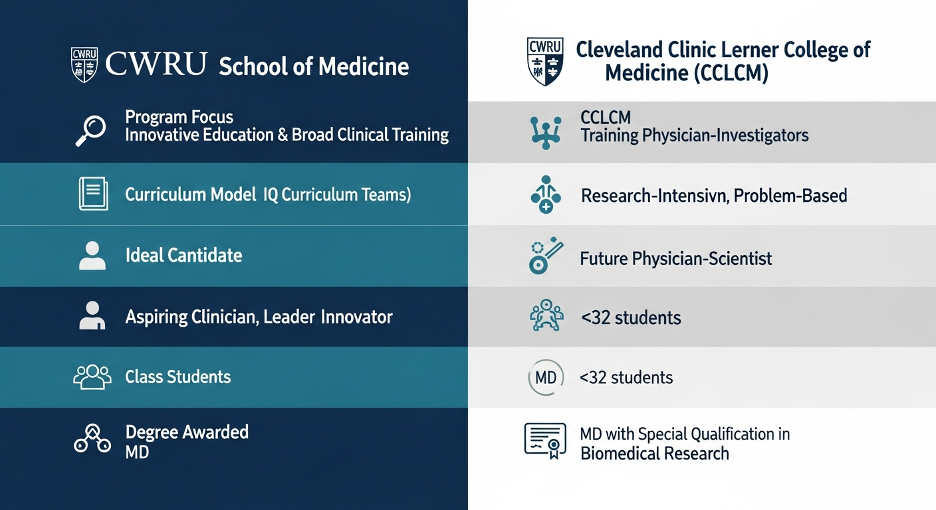
At a glance: Key distinctions between the CWRU School of Medicine and the Cleveland Clinic Lerner College of Medicine programs.

Before you can articulate why you are a good fit, you must intimately understand the institutions themselves. The admissions committee is looking for applicants who have done their homework and can demonstrate a genuine, well-informed interest.

Case Western Reserve University School of Medicine (CWRU SOM)

CWRU SOM is a leader in medical education, known for its forward-thinking approach. The WR2 curriculum is a cornerstone of its identity, emphasizing small-group, case-based learning that integrates basic science with clinical experience from the very beginning. The school prides itself on producing physicians who are not just clinically competent but are also lifelong learners and leaders. They seek medical students who are collaborative, curious, and self-directed—individuals who will thrive in a system that trusts them with significant autonomy in their learning process. Your interview preparation must include a thorough understanding of this curriculum and how your learning style aligns with it.

Cleveland Clinic Lerner College of Medicine (CCLCM)

CCLCM is a distinct entity within CWRU, offering a five-year, tuition-free program dedicated to training physician-scientists. The entire program is structured around a deep immersion in research. From day one, medical students are engaged in a longitudinal research thesis project, supported by world-class mentors at the Cleveland Clinic. The admissions process for CCLCM is intensely focused on an applicant’s potential and passion for research. They are not just looking for past research experience; they are looking for a genuine, insatiable curiosity and a commitment to a career that bridges the laboratory and the clinic.

Shared Values and Synergies

While distinct, both programs are deeply integrated with the city of Cleveland. They share a commitment to addressing urban health challenges and improving health outcomes in the local community. An understanding of Cleveland’s healthcare landscape, including its disparities and opportunities, demonstrates a level of engagement that goes beyond the superficial. Both institutions value innovation, collaboration, and a commitment to advancing medicine, making their partnership a powerful engine for progress.

Demystifying the Interview Process at CWRU & CCLCM

Understanding the structure and logistics of the interview day can significantly reduce anxiety and allow you to focus on what matters: your performance.

Interview Formats You Might Encounter

CWRU and CCLCM have historically used a variety of interview formats. You should be prepared for any of the following:

  • Traditional One-on-One: A conversational interview with a single faculty member or admissions committee member. This format allows for a deep dive into your application and motivations.
  • Panel Interview: You may meet with two or more interviewers simultaneously. This tests your ability to engage with multiple people and manage a dynamic conversation.
  • Multiple Mini-Interview (MMI): This format consists of a series of short, timed “stations,” each presenting a different scenario. These scenarios may involve ethical dilemmas, acting/role-playing, or policy questions, and are designed to assess skills like critical thinking, communication, and professionalism.

The Virtual Interview Experience

In the current landscape, most interviews are conducted virtually. Do not underestimate the importance of preparation for this format. Test your technology thoroughly, secure a quiet and professional-looking space, and ensure you have a neutral background. Dress professionally, just as you would for an in-person interview. Practice making eye contact with the camera, not the screen, to create a more personal connection.

Who You Will Meet

Your interviewers are your future colleagues and mentors. They will likely be a mix of faculty members from various departments, clinicians, researchers, and potentially current medical students. Each brings a different perspective to the evaluation. An interview with a basic science researcher will likely focus more on your research experience, while a session with a current student might explore your understanding of student life and the curriculum.

The Overall Interview Day Structure

A typical interview day, even when virtual, is more than just the formal interviews. It is a comprehensive informational event. Expect introductory sessions from the Dean of Admissions, detailed presentations on the curriculum and financial aid, virtual tours, and informal Q&A sessions with current medical students. Engage actively in every component; your level of interest and professionalism is being observed throughout the day.

Strategic Preparation: Connecting Your Application to Your Interview

Your interview is the final, crucial link in the chain that began with your AMCAS application. It’s time to ensure that chain is strong and seamless.

Revisit Your Entire Application Journey

Begin by rereading your entire application: your AMCAS primary, secondary essays, activities section, and letters of recommendation (if you waived your right to see them, reflect on why you chose those writers). Your interviewers will have this information, and they will use it as a launching point for their questions. Be prepared to elaborate on any experience, answer questions about any grade, and discuss any theme you presented.

Identifying Your Key Narratives and Themes

Your application is a collection of data points; your task now is to connect them into compelling narratives. What are the 2-3 core themes of your application? Perhaps it’s a dedication to serving underserved populations, a passion for unraveling a specific scientific question, or a track record of leadership in challenging situations. Identify these themes and prepare to weave them into your interview responses, providing concrete examples to support them.

The “Maturation” Concept: Reflecting on Growth Since Submission

Your application was likely submitted months ago. What has changed since then? The “maturation” concept is about demonstrating continued growth. Have you taken on new responsibilities at work? Has your research yielded new results? Have you had a new clinical or personal experience that deepened your commitment to medicine? Being able to articulate this growth shows the admissions committee that you are a dynamic, reflective individual who is constantly learning.

Mastering CWRU's Four Cornerstones:
Demonstrating Fit in Your Responses

CWRU SOM explicitly builds its curriculum around four cornerstones. Aligning your experiences and responses with these themes is a powerful way to demonstrate your fit.

Cornerstone 1: Research and Scholarship

For both CWRU and especially CCLCM, this is paramount. Be prepared to discuss your research experience in detail. Go beyond reciting the project title. Explain the hypothesis, your specific role, the challenges you faced, and what you learned from the process—even if the results were not what you expected. Show that you understand the scientific method and can think critically. Express curiosity and mention specific research opportunities at the institution that excite you.

Cornerstone 2: Clinical Mastery

The admissions committee wants to see that you have a realistic understanding of what a career in medicine entails. Reflect on your clinical experiences. What did you observe? How did you interact with patients and healthcare teams? Prepare to share a story that illustrates your empathy, your understanding of the patient experience, or a time you witnessed a difficult clinical or ethical challenge.

Cornerstone 3: Leadership

Leadership in medicine is not just about being in charge; it’s about collaboration, initiative, and motivating others. Think about times you have demonstrated these qualities, whether in a research lab, a student organization, or a volunteer activity. Your response should focus on your actions and their impact on the team or outcome.

Cornerstone 4: Civic Professionalism

This cornerstone speaks to your role as a future physician in society. It encompasses ethics, social responsibility, and a commitment to community. Be prepared to discuss your understanding of health disparities, your community service experiences, and how you see yourself contributing to the health of the Cleveland community.

Excelling in Common Interview Scenarios & Questions

While every interview is unique, certain questions and scenarios are common. Mastering your approach to them is key.

The “Why Medicine?” and “Why CWRU/CCLCM?” Question

These are guaranteed questions. Your “Why Medicine?” response should be a personal, reflective story, not a generic statement. For “Why CWRU/CCLCM?”, your answer must be specific. Mention the WR2 curriculum, a particular research center, a unique clinical program, or a faculty member whose work you admire. Your response must prove you are applying to this specific medical school, not just any medical school.

Behavioral Questions: Storytelling with Impact

Questions beginning with “Tell me about a time when…” require you to tell a concise and impactful story. Use the STAR method to structure your response:

  • Situation: Briefly describe the context.
  • Task: Explain your role or goal.
  • Action: Detail the specific steps you took.
  • Result: Conclude with the outcome and, most importantly, what you learned.

Ethical Questions and Dilemmas

For ethical scenarios, there is often no single “right” answer. The interviewers are assessing your thought process. Acknowledge the complexity of the situation, consider the perspectives of all involved parties, weigh different ethical principles (e.g., autonomy, beneficence), and articulate a reasoned course of action.

Current Healthcare Topics and Debates

You are not expected to be a policy expert, but you should be conversant on major issues affecting the U.S. healthcare system. Be prepared to discuss topics like the Affordable Care Act, healthcare access and costs, or the impact of technology on medicine. Formulate a thoughtful opinion that demonstrates you are engaged with the broader context of your future profession.

Questions for Your Interviewers

Always have several thoughtful questions prepared. Do not ask for information easily found on the school’s website. Instead, ask about their personal experiences, their research, or their perspective on the school’s culture. This demonstrates genuine curiosity and turns the interview into a more engaging, two-way conversation.

The Interview Day: Logistics, Etiquette, and Follow-Up

Professionalism extends beyond the formal interview. Be punctual, courteous to everyone you interact with (including administrative staff and students), and actively engaged throughout the day. Listen attentively and maintain a positive, enthusiastic demeanor. After your interview day, send a prompt and personalized thank-you note or email to each of your interviewers. Reiterate your interest in the program and briefly reference a specific point from your conversation to jog their memory.

Conclusion

Your interview at Case Western Reserve University or the Cleveland Clinic Lerner College of Medicine is your chance to demonstrate that you are more than the sum of your application parts. It is an opportunity to showcase your passion, intellect, and humanity. The key to success lies in deep, program-specific preparation. Understand the unique missions of CWRU SOM and CCLCM. Revisit your own journey and craft compelling narratives that align with their institutional values, especially their profound commitment to research. Practice articulating your thoughts clearly and concisely, and prepare to engage in a genuine, intellectual conversation. By approaching this final challenge with diligence and authenticity, you can confidently present the very best version of yourself to the admissions committee and take a decisive step toward your future in medicine.

Get in!

Ask Us a Question. We help Students just like you
Get Into Case Western & Cleveland Clinic Medical School Every Year!

Contact Page

Standout & Be Remembered!

Get The Cracking Interview Guide

Standout & Be Remembered

If you are prepared, the interview lets you shine and tell people what you are passionate about.
 

Med School Admissions Interview Guide eBook Cover
Scroll to Top