The UCLA Medical School Interview is a monumental achievement in the rigorous medical school application process. Securing an interview at the David Geffen School of Medicine (DGSOM) at UCLA places you among applicants to one of the most prestigious and competitive programs in the nation, particularly among California medical schools. DGSOM seeks candidates who are not only academically brilliant but also possess the compassion, resilience, and innovative spirit to become future leaders in medicine. Your AMCAS application, stellar MCAT score, compelling secondary application, and glowing letters of recommendation have brought you this far. Now, the interview stands as the final—and perhaps most crucial—hurdle between you and a coveted spot in their incoming class.
>> Contact us to schedule a mock interview!
UCLA Medical School Interview Tips
UCLA Pre-Interview Guidance
The David Geffen School of Medicine at UCLA is one of the most competitive and mission-driven medical schools in the country. UCLA looks for applicants who are not only academically strong and clinically prepared, but who also bring a bold, forward-thinking vision for transforming healthcare. Your interview is your chance to show that you are an “Outstanding Physician, AND…”—someone committed to innovation, health equity, leadership, and societal impact.
UCLA typically uses a traditional, conversational format, though interviewers may ask questions probing your vision, your leadership experiences, your understanding of healthcare disparities, and how you will contribute to UCLA’s diverse and service-oriented community.
UCLA Medical School Interview Tip #1: Be bold and articulate your vision for healthcare
UCLA expects interviewees to think like changemakers—not just future clinicians. This mirrors the secondary prompt asking what societal missions you will embrace. In your interview, clearly communicate the healthcare issue you want to improve and how UCLA is the ideal place to help you pursue it.
Example: You might say, “My goal is to expand disability access across Los Angeles by partnering with UCLA’s community engagement programs and leveraging the campus’s interdisciplinary innovation hubs. UCLA’s emphasis on societal missions aligns directly with this vision.”
UCLA Medical School Interview Tip #2: Choose impactful experiences that support your vision
Interviewers may ask you to elaborate on experiences from your application, especially those tied to your “Outstanding Physician, AND…” vision. Make sure the stories you share reinforce the mission you plan to pursue at UCLA.
Example: If your vision involves improving immigrant health, you could explain, “Working in a free clinic serving immigrant families helped me understand the structural barriers they face. This experience solidified my goal to increase healthcare access in underserved communities.”
UCLA Medical School Interview Tip #3: Highlight gap-year or post-college experiences strategically
If you took time between college and medical school, UCLA interviewers may ask how you used that time. Prioritize experiences that demonstrate patient care, meaningful impact, or forward momentum toward your healthcare mission.
Example: You might respond, “During my gap year, I worked as a medical assistant in a community clinic. I not only strengthened my clinical skills but also helped design patient education tools that improved care for non-English-speaking patients.”
UCLA Medical School Interview Tip #4: Incorporate “Why UCLA” throughout the interview
Even when not explicitly asked, you should weave in how UCLA’s programs, values, or opportunities support your goals. Mention specific curricular elements, community partnerships, or research initiatives that align with your mission.
Example: You might say, “UCLA’s emphasis on community-based research and its urban underserved pathways make it the perfect environment for me to expand my work in immigrant health access.”
Sample University of California Los Angeles (UCLA) Medical School Interview Questions & Themes
What does being an “Outstanding Physician, AND…” mean to you?
In recent years, our Cracking Med School Admissions mentees have been asked this question. You NEED to look at your UCLA secondary essays and then reflect your vision there into your UCLA medical school interview response. Show your vision for healthcare and connect it to UCLA’s mission of societal impact.Tell me about an experience that shaped your future mission in medicine.
Choose a story that highlights leadership, innovation, or meaningful impact.How did COVID-19 influence your path to medicine?
Reflect on both personal experiences and the broader inequities you observed. What did you learn from the COVID-19 pandemic that you will apply to improve the future of healthcare. Give specific examples or insights if you can.How have you worked to address disparities or serve underserved communities?
Tie your past work to UCLA’s strong commitment to equity and community health.Why UCLA?
Be specific—mention particular programs, pathways, or research opportunities that connect directly to your healthcare vision. Like we said in the UCLA Medical School interview tip above, you should not wait to be asked “Why UCLA” before answering this question!
Need Help With Your University of California Los Angeles Medical School Interview?
Our Cracking Med School Admissions team has helped countless applicants succeed at UCLA interviews. We’ll work with you to refine your “Outstanding Physician, AND…” narrative, highlight experiences that demonstrate your mission, and practice the types of questions UCLA is known for.
Contact us for a personalized mock interview and feel confident walking into your UCLA interview!
Your medical school application Coaches, Mentors, & Cheerleaders
We Personally Advise Every Student We Work With
Rachel Rizal, M.D.
Changing the trajectory of people's lives
Undergraduate
Princeton University
Medical School
Stanford School of Medicine
Residency
Harvard, Emergency Medicine
Awards & Scholarships
Fulbright Scholar
USA Today Academic First Team
Tylenol Scholarship
Rishi Mediratta, M.D., M.Sc., M.A.
Advising students to attend their dream schools
Undergraduate
Johns Hopkins University
Medical School
Stanford School of Medicine
Residency
Stanford, Pediatrics
Awards & Scholarships
Marshall Scholar
Tylenol Scholarship
Global Health Scholar
Each year, the Cracking Med School Admissions team
helps students get accepted to top medical schools.
We can help you get accepted!
Contact us today.
The Prestige and Promise of UCLA Medical School
DGSOM is renowned for its commitment to research, clinical excellence, and community service. Located in the diverse and dynamic city of Los Angeles, California, it offers unparalleled opportunities for students to engage with a wide spectrum of patient populations and healthcare challenges. The school’s mission to create “a groundbreaking community of problem solvers, caregivers, innovators and life-long learners” is not just a statement; it’s a guiding principle that shapes its curriculum, culture, and the type of student it aims to recruit.
Why the Interview is Your Most Critical Step
Up to this point, the admission committee knows you on paper—your academic performance, your experiences, your test scores. The interview is their opportunity to see the person behind the application. It is a dynamic assessment of your communication skills, ethical reasoning, empathy, and personal alignment with the school’s core values. A strong interview performance can solidify your position as a top candidate, while a weak one can raise doubts, regardless of how impressive your application is. This is your chance to bring your story to life.
What This Guide Will Cover: A Focused Prep Strategy
This guide provides a comprehensive strategy to help you navigate and excel in your DGSOM interview. We will deconstruct the unique interview formats used by UCLA, explore what the admissions committee is looking for, and offer actionable techniques for preparation and execution. From mastering the Multiple Mini-Interview (MMI) to crafting your personal narrative for the traditional interview, this guide is your roadmap to presenting the most authentic and compelling version of yourself.
download your interview guide
If you are prepared, the interview gives you the perfect opportunity to standout and shine by sharing with people what you are passionate about.
Understanding the DGSOM Interview Landscape
Before diving into preparation, it’s essential to understand the context of the DGSOM interview. The UCLA admissions committee employs a multifaceted approach to evaluate applicants, looking for qualities that statistics alone cannot capture.
The UCLA interview format has changed frequently over the years since the COVID-19 pandemic. Some years, it’s MMI only. Other years it’s traditional only. And for the unlucky years, there is both a hybrid traditional and MMI format. In this blog post, we will cover it all. So, below, we will talk about the hybrid interview format, so that you’re ready for any UCLA medical school interview! 🙂
The Dual Approach: MMI and Traditional Interviews at UCLA
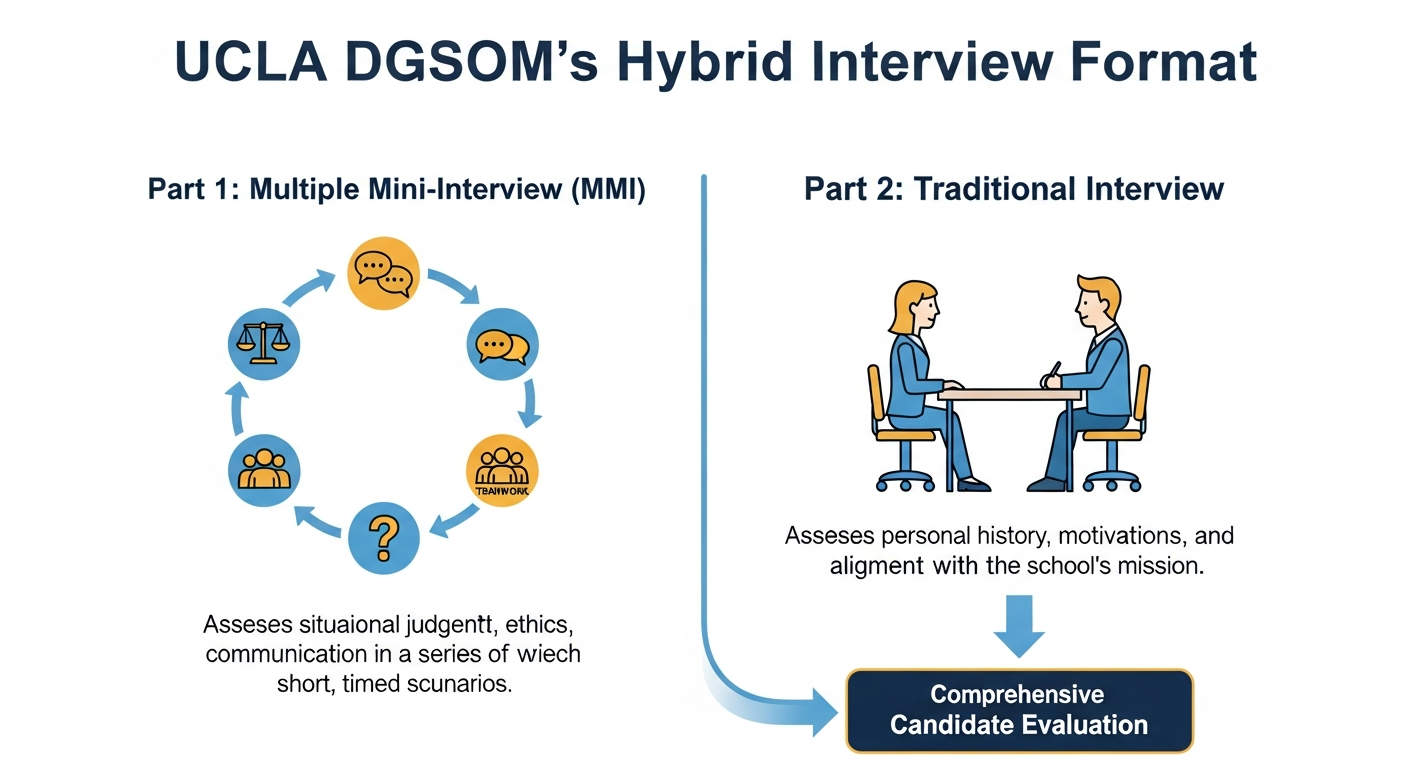
by Cracking Med School Admissions
DGSOM’s hybrid interview combines the MMI and a traditional format to create a holistic picture of each applicant.
DGSOM typically utilizes a hybrid interview format, combining the Multiple Mini-Interview (MMI) with a traditional one-on-one interview. This dual approach allows them to assess a broad range of competencies. The MMI is designed to evaluate your problem-solving skills, ethical judgment, and ability to think on your feet through a series of short, structured scenarios. The traditional interview provides a more personal setting for an interviewer to delve deeper into your motivations, experiences, and specific interest in UCLA.
DGSOM’s Core Values and Mission: What They’re Looking For
Your entire interview performance should be framed by DGSOM’s mission. The school actively seeks applicants who demonstrate:
- Innovation: A curiosity and drive to advance medical knowledge and practice.
- Collaboration: The ability to work effectively in diverse teams.
- Compassion: Genuine empathy and a commitment to patient-centered care.
- Leadership: The potential to influence and improve healthcare systems.
- Social Responsibility: A dedication to addressing health disparities and serving underserved communities.
Every response you give should, in some way, reflect these core principles.
The Holistic Review Process: Beyond GPA and MCAT Scores
UCLA’s commitment to a holistic review means that every part of your application process contributes to the final admission decision. While a strong GPA and MCAT score are necessary to be competitive, the interview is where you prove you possess the non-cognitive skills essential for a successful medical student and physician. They are looking for evidence of resilience, maturity, cultural competence, and a genuine passion for the art and science of medicine.
Mastering the Multiple Mini-Interview (MMI) at DGSOM
The MMI can be the most intimidating part of the interview day for many applicants. However, with the right preparation, it becomes an opportunity to showcase a wide range of your strengths.
Deconstructing the DGSOM MMI: Format and Objectives
The DGSOM MMI consists of several independent “stations.” At each station, you are given a prompt—often a scenario involving an ethical dilemma, a policy question, or an interpersonal conflict—and a short time (e.g., two minutes) to prepare your response. You then enter a room (or virtual breakout room) and discuss the prompt with an evaluator for a set period (e.g., six to eight minutes). The objective is not to find a single “right” answer but to demonstrate your thought process, communication skills, and ethical framework.
Strategies for Excelling in Each MMI Station
- Structure Your Response: Don’t just dive in. Take a moment to structure your thoughts. A helpful framework is to identify the key issues, consider the perspectives of all involved parties, outline potential courses of action with their pros and cons, and then state your chosen path and its justification.
- Acknowledge Complexity: Most MMI scenarios are intentionally designed to be complex with no easy solution. Acknowledge this ambiguity in your response. Phrases like, “This is a challenging situation with competing ethical principles,” show the evaluator you appreciate the nuance.
- Think Out Loud: Clearly articulate your reasoning. The evaluator is more interested in how you think than what you conclude. Walk them through your decision-making process step-by-step.
- Maintain Professionalism: Even when faced with a difficult or emotionally charged scenario, maintain a calm and professional demeanor. This demonstrates your capacity to handle the pressures inherent in a medical career.
Connecting Your Responses to DGSOM’s Values
As you formulate your response to a scenario, subtly connect it to UCLA’s values. If the scenario involves a conflict between colleagues, you can emphasize the importance of collaborative problem-solving. If it involves a vulnerable patient, you can frame your response around compassionate, patient-centered care. This demonstrates a deep understanding of the institution’s culture.
Practical MMI Interview Preparation Techniques
Practice is non-negotiable for the MMI. Work with pre-med advisors, mentors, or peers. Use sample MMI prompts found online and time yourself. Record your responses to analyze your pacing, body language, and clarity. The goal is to become comfortable with the format so you can focus on the content of your response on interview day.
Excelling in the Traditional Interview at DGSOM
The traditional interview is your chance to connect with an interviewer on a personal level and articulate why you are an ideal candidate for DGSOM.
The Purpose of the Traditional Interview: Deeper Dive into Your Story
This component of the interview allows the admission committee to understand your journey to medicine. The interviewer will likely have access to your AMCAS application and will ask questions about your experiences, motivations, and goals. This is where you connect the dots, weaving the various elements of your application into a coherent and compelling narrative.
Crafting Your Compelling “Why DGSOM” Narrative
A generic response to “Why UCLA?” is a missed opportunity. Your answer must be specific and multi-layered.
- Connect to the Curriculum: Mention specific aspects of the DGSOM curriculum that appeal to you, such as the emphasis on early clinical exposure or specific scholarly pathways.
- Align with Research: If you have research interests, identify faculty members or labs at UCLA whose work excites you. Explain how you could contribute and what you hope to learn.
- Embrace the Location: Discuss how you want to engage with the unique patient populations of Los Angeles and contribute to addressing the city’s specific health challenges. This is especially important for demonstrating a commitment to serving California.
- Fit the Culture: Refer back to DGSOM’s mission and explain how your own values and experiences align with their focus on innovation, community, and leadership.
Articulating Your Experiences with Impact
When discussing activities from your application—be it research, volunteering, or clinical work—don’t just describe what you did. Focus on what you learned, how you grew, and the impact you made. Use the STAR method (Situation, Task, Action, Result) to structure your answers, ensuring you clearly convey the significance of each experience.
Preparing Thoughtful Questions for Your Interviewer
At the end of the interview, you will be invited to ask questions. This is not a formality; it is a chance to demonstrate your genuine interest and intellectual curiosity. Prepare several thoughtful questions that cannot be easily answered by browsing the school’s website. Ask about the interviewer’s own experience at UCLA, student life, or specific opportunities you are passionate about.
Leveraging Your Application for Interview Success
Your written application and your interview are not separate entities; they are two parts of a single, cohesive presentation of your candidacy.
Building on Your AMCAS and Secondary Application
Re-read your entire AMCAS and DGSOM secondary application before your interview. Be prepared to elaborate on anything you wrote, from your most meaningful experiences to the answer to a specific essay prompt. The interview is your chance to add depth and personality to the stories you’ve already shared in your secondaries. Think of your application as the script and the interview as the live performance.
Showcasing Your Academic and Experiential Foundation
While interviewers will focus on personal qualities, they will do so through the lens of your experiences. Be ready to discuss challenges in your academic performance, what you learned from a difficult course, or how your research experience shaped your critical thinking skills. This demonstrates self-awareness and the ability to learn from every part of your journey.
The Role of the AAMC PREview Exam
For some tracks, DGSOM has incorporated the AAMC PREview exam, which assesses professional competencies. While distinct from the interview, your performance on this exam helps create a broader picture of your interpersonal skills and ethical judgment. Your approach to the interview’s situational judgment questions should align with the professional conduct assessed by the PREview exam, demonstrating consistency in your character and decision-making.
Pre-Interview Preparation: The Road to Confidence
Thorough preparation is the key to transforming anxiety into confidence on interview day.
Deep Dive Research on David Geffen School of Medicine
Go beyond the homepage of the DGSOM website. Read about their affiliated hospitals, community outreach programs like the Mobile Clinic Project, and recent research publications. Explore student organizations and special programs like PRIME-LA for leaders addressing policy and management in healthcare. The more you know, the more you can tailor your answers and demonstrate authentic interest.
Intensive Mock Interview Practice
Engage in at least two or three full-length mock interviews. One should be a mock MMI, and another should be a traditional one-on-one format. Ask for honest, critical feedback on the content of your answers, your communication style, and your overall presence. This is the single most effective way to identify and correct weaknesses before the actual interview.
Developing a Strong “Interview Day Mindset”
On the days leading up to your interview, focus on building a positive and confident mindset. Remind yourself that an interview invitation means the admission committee already believes you are a qualified candidate. Your job is not to prove you are “smart enough” but to show them who you are as a person and future colleague. Get adequate sleep, eat a healthy meal, and do something relaxing the day before.
Interview Day Execution: Making a Lasting Impression
All your preparation culminates in your performance on the day of the interview.
Logistics and Environment for Virtual Interviews
If your interview is virtual, treat it with the same seriousness as an in-person meeting.
- Technology: Test your camera, microphone, and internet connection thoroughly beforehand.
- Environment: Choose a quiet, well-lit space with a professional, uncluttered background.
- Attire: Wear professional attire from head to toe.
- Engagement: Maintain eye contact by looking at the camera, not just the screen. Use non-verbal cues like nodding and smiling to show you are engaged.
On-Campus Interview Day (if applicable): Navigating the DGSOM Campus
If you are invited for an on-campus interview, plan your travel to arrive with plenty of time to spare. Be polite and professional to everyone you meet, from administrative staff to current students. The entire day is part of your evaluation. Use campus tours and informal sessions to gather more information and further demonstrate your enthusiasm for the program. Your interactions throughout the day contribute to the overall impression you leave.
Conclusion
Acing your interview at the David Geffen School of Medicine is the capstone of a long and demanding application process. Success hinges on deep preparation, self-reflection, and a genuine understanding of what makes UCLA a unique institution. By deconstructing the MMI and traditional interview formats, you can develop targeted strategies to showcase your strengths. Remember to ground every response in the school’s core values of innovation, compassion, and community leadership. Leverage your entire application—from your AMCAS and secondary application to your academic performance—to build a cohesive narrative that highlights not just what you have done, but who you are and the physician you aspire to become. Practice diligently, research thoroughly, and enter your interview with the confidence that you have earned your place there. This is your moment to demonstrate that you are ready to join the next generation of medical leaders at UCLA.

