

The UConn Medical School Interview is a monumental achievement. Receiving an interview invitation from the University of Connecticut School of Medicine signifies that your academic record, MCAT score, and primary application have distinguished you from a vast pool of highly qualified candidates. Now, the final and most personal hurdle stands between you and an acceptance: the interview. This is your opportunity to transcend the data points on your application and present yourself as a compassionate, competent, and collaborative future physician who belongs in the UConn community.
Contact us if you have questions about your upcoming UConn Medical School Interview or if you want to do mock interviews with our team!
UConn Medical School Interview Tips
UConn Pre-Interview Guidance
The University of Connecticut School of Medicine (UConn SOM) is known for its strong commitment to primary care, patient-centered training, and community health. As a public institution, UConn emphasizes serving diverse populations across Connecticut while fostering collaboration, professionalism, and deep reflection. Your interview will typically follow a traditional format, though conversational in tone, and will give faculty and students the chance to understand your motivations, your preparation for a career in medicine, and how your experiences align with UConn’s mission.
During your interview, be prepared to speak thoughtfully about your healthcare experiences, your connection to Connecticut (if applicable), and how UConn’s curriculum and values fit with your personal journey.
UConn Medical School Interview Tip #1: Incorporate stories into your answers
Just as UConn’s secondary prompts encourage storytelling—even in short responses—your interview answers should highlight specific patient encounters, challenges, or moments of clarity that shaped your path to medicine. Stories help your interviewers understand not just what you did, but who you are and why you’re a strong match for UConn SOM.
Example: If asked about insights gained from patient care, you might describe a moment when a non-English-speaking patient struggled to navigate the healthcare system during your volunteer shift. You could share what you learned about barriers to care and how it reinforced your desire to practice compassionate, accessible medicine—values emphasized at UConn.
>> Prepare with our Cracking Med Team through mock interviews!
UConn Medical School Interview Tip #2: Bring a comprehensive view of your healthcare experiences
UConn values applicants with diverse clinical backgrounds. Whether you were a medical assistant, physical therapist, nurse, EMT, or clinic volunteer, these experiences are excellent preparation for medical school—even if they did not involve working directly with physicians. Come ready to explain what you observed, what you learned, and how these experiences shaped your understanding of the physician role.
Example: If you worked as a physical therapy aide, you could highlight how observing long-term patient recovery taught you the importance of multidisciplinary collaboration. Then connect this to UConn’s integrated curriculum and team-based care approach.
UConn Medical School Interview Tip #3: Mention personal or institutional connections authentically
If you have spoken with UConn students, alumni, faculty, or mentors affiliated with the institution, weave these insights into your interview. Genuine personal connections can show that you have taken initiative to learn about the school’s culture, clinical opportunities, and values.
Example: You might say, “When I spoke with a UConn alum who now practices family medicine, she emphasized how the school nurtures strong clinical confidence early on. This resonated with me because hands-on learning is something I’m actively seeking in my training.”
UConn Medical School Interview Tip #4: Answer “Why UConn?” with specificity
One of UConn’s secondary prompts asks how the school will serve your needs as a future physician or physician-scientist, and this theme will certainly appear during your interview. Go beyond generic mentions of research or community service. Instead, tie UConn’s unique strengths—like the MDelta curriculum, opportunities at UConn Health, or the school’s focus on primary care—to your long-term interests.
Example: If you’re passionate about community-based medicine, connect your past service to UConn’s Urban Service Track or partnerships with Connecticut community clinics. Explain how these programs will help you continue serving diverse patient populations.
UConn Medical School Interview Tip #5: Be ready to discuss challenges you anticipate as a physician
One of UConn’s key secondary questions asks what problems you expect to face as a physician, and your interviewers may explore this topic further. Be prepared to reflect on challenges you witnessed firsthand—systemic barriers, patient communication issues, provider burnout—and articulate how you plan to navigate them with professionalism and resilience.
Example: If you observed long wait times during your clinical volunteer work, you could reflect on how system inefficiencies affect patient outcomes and why you hope to be part of improving care delivery.
Sample University of Connecticut Medical School Interview Questions & Themes
- Why UConn?
Tie UConn’s curriculum, clinical training sites, and mission to your long-term goals and Connecticut-rooted experiences. - Tell me about your healthcare experiences.
Provide stories showing what you learned, the challenges you witnessed, and how these experiences shaped your path. - What challenges do you think you will face as a physician?
Draw from real observations and explain how you plan to handle these challenges with maturity and self-awareness. - Do you have any connections to UConn or Connecticut?
Share genuine insights from conversations or personal ties that helped shape your understanding of the school. - Discuss a meaningful patient interaction.
Use storytelling to highlight empathy, communication, and your growth as a future physician.
Need Help With Your University of Connecticut (UConn) Medical School Interview?
Our team at Cracking Med School Admissions has helped countless students succeed at UConn SOM interviews. We offer tailored mock interviews that help you refine your storytelling, sharpen your “Why UConn?” answer, and master challenging scenario questions.
Contact us today to start preparing with confidence!
Your medical school application Coaches, Mentors, & Cheerleaders
We Personally Advise Every Student We Work With

Rachel Rizal, M.D.
Changing the trajectory of people's lives
Undergraduate
Princeton University
Medical School
Stanford School of Medicine
Residency
Harvard, Emergency Medicine
Awards & Scholarships
Fulbright Scholar
USA Today Academic First Team
Tylenol Scholarship

Rishi Mediratta, M.D., M.Sc., M.A.
Advising students to attend their dream schools
Undergraduate
Johns Hopkins University
Medical School
Stanford School of Medicine
Residency
Stanford, Pediatrics
Awards & Scholarships
Marshall Scholar
Tylenol Scholarship
Global Health Scholar
Each year, the Cracking Med School Admissions team
helps students get accepted to top medical schools.
We can help you get accepted!
Contact us today.
Welcome to Your Definitive UConn Interview Guide
This guide is designed to be your comprehensive resource for navigating every aspect of the UConn School of Medicine interview for the 2024-2025 application cycle. We will move beyond generic advice, offering specific, actionable strategies tailored to UConn’s unique culture, curriculum, and what its Admissions Committee values most in prospective medical students.
Why the Interview is Pivotal for Your UConn Application
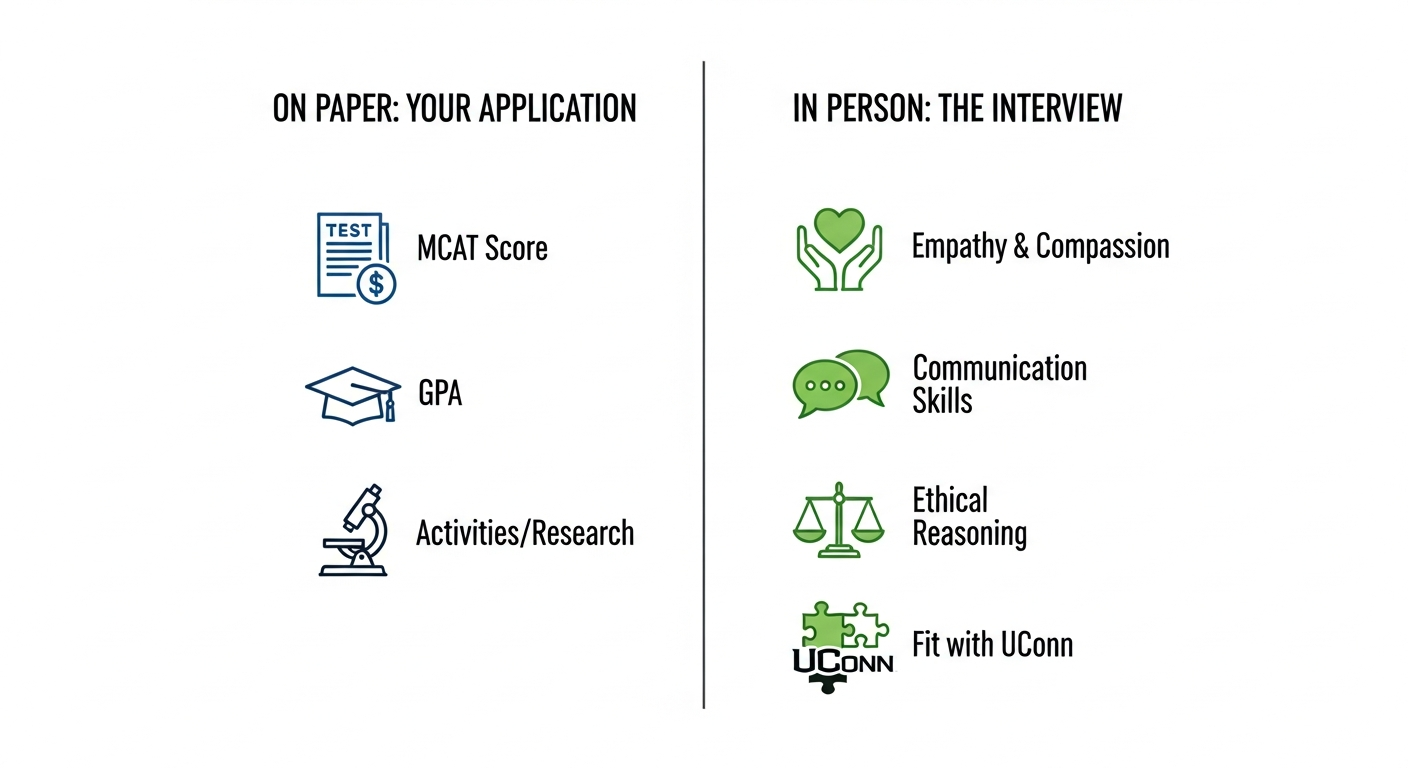
Your application demonstrates your academic readiness, while the interview evaluates the essential human qualities of a future physician.
Your application has already demonstrated your academic capabilities. The interview, however, serves a different purpose. It is a critical assessment of your interpersonal skills, ethical reasoning, motivation for medicine, and—most importantly—your fit with the UConn School of Medicine. The faculty and admissions members want to know if you possess the maturity, empathy, and resilience necessary to become an outstanding physician and a contributing member of their learning environment. A strong interview performance can significantly elevate your application, while a poor one can cast doubt on an otherwise stellar profile.
Setting the Stage: What to Expect from This Guide
From understanding the institutional mission that drives medical education at UConn to demystifying the interview format and mastering your responses, this guide will provide a structured roadmap. We will explore the journey from your secondary application to the interview day, break down common question types, and provide strategies for articulating your unique story. By the end, you will be equipped with the knowledge and confidence to excel.
download your interview guide
If you are prepared, the interview gives you the perfect opportunity to standout and shine by sharing with people what you are passionate about.

Understanding UConn School of Medicine: Laying the Foundation for Your Interview
A successful interview is rooted in a deep understanding of the institution. Demonstrating a genuine, well-researched interest in the University of Connecticut goes far beyond a surface-level “Why UConn?” answer. It requires you to align your personal journey and future goals with the school’s core identity.
UConn’s Core Mission and Values: What Drives Their Medical Education
The UConn School of Medicine is dedicated to training physicians who are not only scientifically proficient but also humanistic and dedicated to serving the needs of Connecticut and beyond. Key pillars of their mission often include a commitment to primary care, addressing health disparities, fostering innovation through research, and promoting lifelong learning. Your interview responses should reflect an understanding of these principles. Show the Admissions Committee that your personal mission as a future physician aligns with their institutional goals.
Distinguishing Features of UConn: How to Articulate Your Fit
To truly stand out, you must connect your experiences to UConn’s specific programs. Research and be prepared to discuss elements like:
- The MDelta Curriculum: This integrated curriculum features longitudinal “threads” covering topics from health justice to evidence-based medicine. Consider which threads resonate most with your experiences and interests. How has your background prepared you to engage with these themes?
- Research Opportunities: UConn boasts robust research programs. If you have research experience, identify a faculty member or lab whose work excites you. Be ready to discuss not just your past projects but also how you hope to contribute to the research landscape at UConn.
- Community Engagement: UConn has a strong focus on serving local populations. Highlight any community service or clinical experiences that show your commitment to patient populations similar to those in Connecticut.
What the Admissions Committee Looks For: Beyond Scores
The Admissions Committee at UConn employs a holistic review process. They are looking for candidates who bring diverse perspectives and life experiences to the classroom. They want to see evidence of qualities that cannot be measured by an MCAT score:
- Empathy and Compassion: Demonstrated through clinical and volunteer experiences.
- Teamwork and Collaboration: Shown in team-based activities, research, or work.
- Resilience and Maturity: Articulated when discussing challenges and personal growth.
- Intellectual Curiosity: Evidenced by a passion for learning and inquiry beyond coursework.
- Self-Awareness: The ability to reflect on your strengths, weaknesses, and motivations.
Navigating the Application Journey to Your UConn Interview
The interview is the culmination of a long and detailed application process. Each preceding step has laid the groundwork for the narrative you will present to the interviewers.
The Application Timeline: Where the Interview Fits In
The medical school application cycle is a marathon. After submitting your primary AMCAS application, you likely received and completed UConn’s secondary application. An interview invitation, typically sent between late summer and early spring, is the next critical milestone. It confirms that the Admissions Committee sees significant potential in your written application and wants to learn more. Following the interview, you will await a final admission decision, which can come on a rolling basis.
From AMCAS to Secondary: How Your Application Informs the Interview
Your interviewers will have access to your entire application file, including your personal statement, activities list, and Secondary Essays. This is an advantage. They already know the “what” of your experiences; the interview is your chance to explain the “why” and “how.” Be prepared to elaborate on any aspect of your application. The themes you introduced in your Secondary Essays—such as your unique identity, how you’ll enhance the community, and your understanding of the problems a physician will face—are prime topics for deeper conversation.
Understanding UConn’s Holistic Review Process
Holistic review means every piece of your application matters. UConn is looking for a complete picture of who you are. While strong academics are a prerequisite, they are not the sole determinant of success. Your life experiences, personal attributes, and alignment with the school’s mission are weighed heavily. The interview is the ultimate tool of this holistic process, allowing the committee to see the person behind the paper.
CASPer Test Considerations (If Required by UConn for 2024-2025)
Situational judgment tests like CASPer are used by some medical schools to assess non-cognitive skills such as professionalism, ethics, and empathy. It is critical to check the UConn School of Medicine admissions website directly for the 2024-2025 cycle to confirm if CASPer is a requirement. If it is, prepare for it as you would any other standardized test, focusing on understanding its format and practicing with sample scenarios.
Demystifying the UConn Interview Format and Logistics
Knowing what to expect on interview day can significantly reduce anxiety and help you perform at your best. Familiarize yourself with the process from the moment you receive your invitation.
Receiving the Interview Invitation: What to Expect Next
An interview invitation from UConn will typically arrive via email. Respond promptly and professionally to schedule your date. The email will contain crucial information regarding the format (virtual or in-person), the platform used (e.g., Teams), the schedule for the day, and any required pre-interview tasks. Read all provided materials carefully.
Understanding the Interview Day Structure
A typical interview day, whether virtual or in-person, is more than just the formal interview. It is designed to be a comprehensive, bidirectional experience. It may include:
- An orientation and welcome from the Dean of Admission.
- An information session about the curriculum and financial aid.
- Q&A sessions with current medical students.
- One or more one-on-one or panel interviews.
- A virtual or in-person tour of the campus and facilities.
Engage actively in every component; you are being evaluated throughout the day.
Who Will Be Interviewing You? (Physicians, Faculty, Residents, Admissions Committee Members)
Your interviewers at UConn could be a mix of individuals, including practicing physicians affiliated with the school, basic science or clinical faculty, residents, and dedicated members of the Admissions Committee. Each brings a unique perspective. A physician may focus on your clinical understanding and motivation, while a research faculty member might probe your scientific curiosity. Treat every interviewer with the same level of respect and professionalism.
Technical Preparations for Virtual Interviews (If Applicable)
If your interview is conducted virtually via a platform like Teams, technical preparedness is non-negotiable.
- Test Your Tech: Check your camera, microphone, and internet connection well in advance.
- Create a Professional Setting: Choose a quiet, well-lit location with a neutral background. Ensure you will not be interrupted.
- Dress Professionally: Wear the same professional attire you would for an in-person interview.
- Practice Eye Contact: Look at the camera, not just the screen, to simulate direct eye contact with your interviewer.
Mastering UConn Interview Content: Key Themes and Question Types
Preparation is about anticipating the types of questions you will face and developing thoughtful, authentic answers that showcase your strengths.
UConn-Specific Interview Prompts: Anticipating the Questions
Expect questions that directly probe your interest in the University of Connecticut. These are designed to assess the depth of your research and the sincerity of your interest.
- “Why are you specifically interested in the UConn School of Medicine?”
- “Which aspects of our MDelta curriculum appeal to you and why?”
- “How do you see yourself contributing to our campus community?”
- “What do you hope to gain from studying medicine in Connecticut?”
Common Behavioral Questions and How to Excel
Behavioral questions ask you to provide specific examples from your past to demonstrate key competencies. The STAR method (Situation, Task, Action, Result) is an effective framework for structuring your answers.
- “Tell me about a time you worked on a team.”
- “Describe a significant challenge you faced and how you overcame it.”
- “Give an example of a time you had to resolve a conflict.”
Ethical Dilemmas and Situational Judgment Questions
These questions assess your moral reasoning and ability to think through complex, ambiguous situations. There is often no single “right” answer. The goal is to demonstrate a logical, compassionate, and balanced thought process. You might be asked about patient confidentiality, resource allocation, or conflicts of interest. Articulate your understanding of the different perspectives involved before explaining your proposed course of action.
Preparing for MD/PhD Specific Questions (If Applicable)
If you are applying to the combined MD/PhD program, expect a rigorous evaluation of your research background and commitment to a career as a physician-scientist. Be prepared to:
- Discuss your past research projects in detail, including the hypothesis, your specific role, and the outcomes.
- Articulate why a combined degree is essential for your career goals.
- Identify specific faculty at UConn with whom you would want to conduct your PhD research.
Developing a Winning UConn Interview Strategy
A successful interview strategy integrates in-depth knowledge with effective communication and genuine enthusiasm.
In-Depth Research of UConn School of Medicine
Go beyond the admissions homepage. Read about recent research publications from UConn faculty. Look into student organizations and community outreach programs that align with your interests. Familiarize yourself with UConn Health and its affiliated hospitals. The more specific your knowledge, the more authentic your interest will appear.
Crafting Compelling Narratives: Telling Your Story Effectively
Your interview is a chance to weave the disparate elements of your application into a cohesive and compelling story. Identify two or three core themes about yourself that you want the committee to remember (e.g., your commitment to underserved populations, your passion for discovery, your leadership abilities). Find ways to thread these themes through your answers.
Practicing for Success: Mock Interviews and Self-Assessment
Practice is essential, but be careful not to sound overly rehearsed. Conduct mock interviews with mentors, advisors, or peers. Record yourself to analyze your body language, pacing, and use of filler words. The goal of practice is to become so comfortable with your own stories that you can deliver them naturally and confidently.
Effective Communication Techniques During the Interview
- Listen Carefully: Make sure you fully understand the question before you begin to answer.
- Think Before You Speak: It is perfectly acceptable to take a brief pause to formulate your thoughts.
- Be Concise and Clear: Provide a direct answer to the question before elaborating with examples.
- Ask Thoughtful Questions: Prepare insightful questions for your interviewers about their experience at UConn, the school’s culture, or future directions. This demonstrates your engagement and intellectual curiosity.
Demonstrating Genuine Fit and Enthusiasm for UConn
Throughout the interview, your passion for medicine and your specific interest in UConn should be palpable. Connect your personal and professional goals to the unique opportunities the School of Medicine offers. Show them not just why you are a great candidate for medical school, but why you are a perfect fit for the University of Connecticut.
Conclusion
The University of Connecticut School of Medicine interview is your final, critical opportunity to demonstrate that you are the right fit for their program. Success hinges on a foundation of thorough preparation, self-reflection, and genuine enthusiasm. By deeply understanding UConn’s mission, anticipating key question themes, and crafting a compelling personal narrative, you can present a confident and authentic version of yourself. Remember to connect your experiences directly to the unique aspects of UConn’s curriculum, research, and community. Prepare your technology for a virtual setting, practice your delivery, and go into the day ready to engage thoughtfully with faculty and students. Your journey to becoming a physician has led you to this point; embrace the opportunity to show the Admissions Committee the capable and compassionate leader you are poised to become.