

The University of California, Riverside Medical School Admissions Committee is extremely selective about who gets an interview. It cares about the commitment to Riverside and the Inland Empire. Congratulations if you receive an interview invite to UCr! The UCR Medical School Interview is a monumental step in your journey to becoming a physician that serves immigrants from Mexico and South America. Receiving an interview invitation from the University of California, Riverside School of Medicine signifies that the Admissions Committee sees promise in your application and believes you have the potential to thrive within their unique, mission-driven community. This interview is your opportunity to transcend the pages of your application and demonstrate the personal qualities, motivations, and understanding that make you an ideal candidate for this specific medical school. It is the final, most personal challenge before a potential offer of admission.
>> Contact us to schedule a mock interview!
UCR Medical
School Interview Tips
UCR Pre-Interview Guidance
The University of California Riverside (UCR) School of Medicine is deeply mission-driven, with a strong commitment to training physicians who will serve the Inland Empire’s medically underserved communities. UCR looks for applicants who not only understand the region’s unique healthcare challenges—such as physician shortages, healthcare disparities, and immigrant health needs—but who also feel personally connected to addressing them.
Expect a traditional, conversational interview format. Your interviewers will evaluate your alignment with UCR’s service-oriented mission, your understanding of the patient populations in the Inland Empire, and your commitment to primary care or community-focused care. This is your opportunity to demonstrate not just why you want to become a physician, but why UCR is the right school for your training.
UCR Medical School Interview Tip #1: Show deep commitment to the Inland Empire
UCR heavily prioritizes applicants who want to serve the Inland Empire. Go beyond saying you “care about underserved communities” and explain why this specific region resonates with you. If you have experience with LatinX communities, agricultural workers, immigrant populations, or healthcare access initiatives, tie it directly to the needs of Riverside and San Bernardino Counties.
Example: “While volunteering at a free clinic serving migrant farmworkers, I saw firsthand how language barriers, transportation challenges, and limited insurance options affect care. These experiences motivate me to train at UCR, where I can continue working with communities that face similar barriers in the Inland Empire.”
UCR Medical School Interview Tip #2: Highlight UCR’s core values with a patient-centered story
UCR values integrity, innovation, inclusion, excellence, accountability, and respect. Instead of talking about an abstract definition of a value, bring your answer to life with a patient story—ideally one where you played an active role in the patient’s care.
Example: “During my time as a medical assistant, I cared for a patient experiencing homelessness who struggled to manage her diabetes. I demonstrated accountability by coordinating her follow-up visits and staying late to ensure she received transportation vouchers. This hands-on experience showed me how accountability directly impacts patient outcomes.”
UCR Medical School Interview Tip #3: Be ready to discuss personal challenges with maturity and insight
UCR often asks about challenges and resilience. Interviewers want to hear a story that demonstrates growth, not a superficial academic setback like “I got a low grade.” Choose a meaningful challenge, explain the context, share how you overcame it, and reflect on how it shaped the person—and future physician—you are becoming.
Example: “When my father lost his job, I took on additional work hours to support my family. Balancing school, work, and caregiving taught me time management, perseverance, and empathy—qualities I will carry with me as a medical student and physician.”
UCR Medical School Interview Tip #4: Emphasize your interest in primary care—even if you’re undecided
UCR strongly emphasizes training primary care physicians who will practice locally. You don’t have to commit to a specialty, but you should express openness or enthusiasm for primary care, preventive medicine, and continuity of care. However, we strongly recommend you include primary care experiences and patients; weave these stories into your interview. Then, connect the dots with how you will continue to serve patients in the Inland Empire based on your experiences.
Example: “I see myself working in an outpatient setting where I can build long-term relationships with patients, especially those facing chronic disease and social barriers to care. This aligns with UCR’s focus on community-based and primary care training.”
Sample University of California Riverside (UCR) Medical School Interview Questions & Themes
Why do you want to train at UCR specifically?
Highlight the Inland Empire connection, underserved patient care, and mission fit. This is extremely important.How have you worked with underserved, LatinX, or immigrant populations?
Connect your experiences directly to the populations UCR serves.Tell me about a personal challenge you faced and how you demonstrated resilience.
Choose a meaningful, non-academic challenge and focus on growth.Which UCR core value resonates most with you?
Use a concrete patient story that demonstrates your chosen value.What kind of physician do you hope to become?
Emphasize primary care interest, health equity, or community medicine.
Need Help With Your University of California Riverside (UCR) Medical School Interview?
Our Cracking Med School Admissions team has helped hundreds of applicants succeed at mission-driven schools like UCR. We’ll guide you through your service stories, refine your responses about the Inland Empire, and help you prepare for values-based questions.
If you want to feel confident, polished, and ready for your UCR interview. Contact us to schedule a mock interview today!
Your medical school application Coaches, Mentors, & Cheerleaders
We Personally Advise Every Student We Work With

Rachel Rizal, M.D.
Changing the trajectory of people's lives
Undergraduate
Princeton University
Medical School
Stanford School of Medicine
Residency
Harvard, Emergency Medicine
Awards & Scholarships
Fulbright Scholar
USA Today Academic First Team
Tylenol Scholarship

Rishi Mediratta, M.D., M.Sc., M.A.
Advising students to attend their dream schools
Undergraduate
Johns Hopkins University
Medical School
Stanford School of Medicine
Residency
Stanford, Pediatrics
Awards & Scholarships
Marshall Scholar
Tylenol Scholarship
Global Health Scholar
Each year, the Cracking Med School Admissions team
helps students get accepted to top medical schools.
We can help you get accepted!
Contact us today.
The Significance of the UCR Interview in Your Application Journey
Unlike many other medical schools, the UCR School of Medicine has a profound and specific mission: to improve the health of the people of California, with a special focus on serving the diverse and medically underserved Inland Southern California region. Your primary application, Secondary Application, and Letters of Recommendation have brought you this far. The interview, however, is the ultimate test of fit. It assesses not just your academic prowess or clinical experiences but your genuine alignment with this mission. A strong performance can solidify your position as a top applicant, while a lack of preparation can raise questions about your commitment.
What Makes the UC Riverside Medical School Interview Unique?
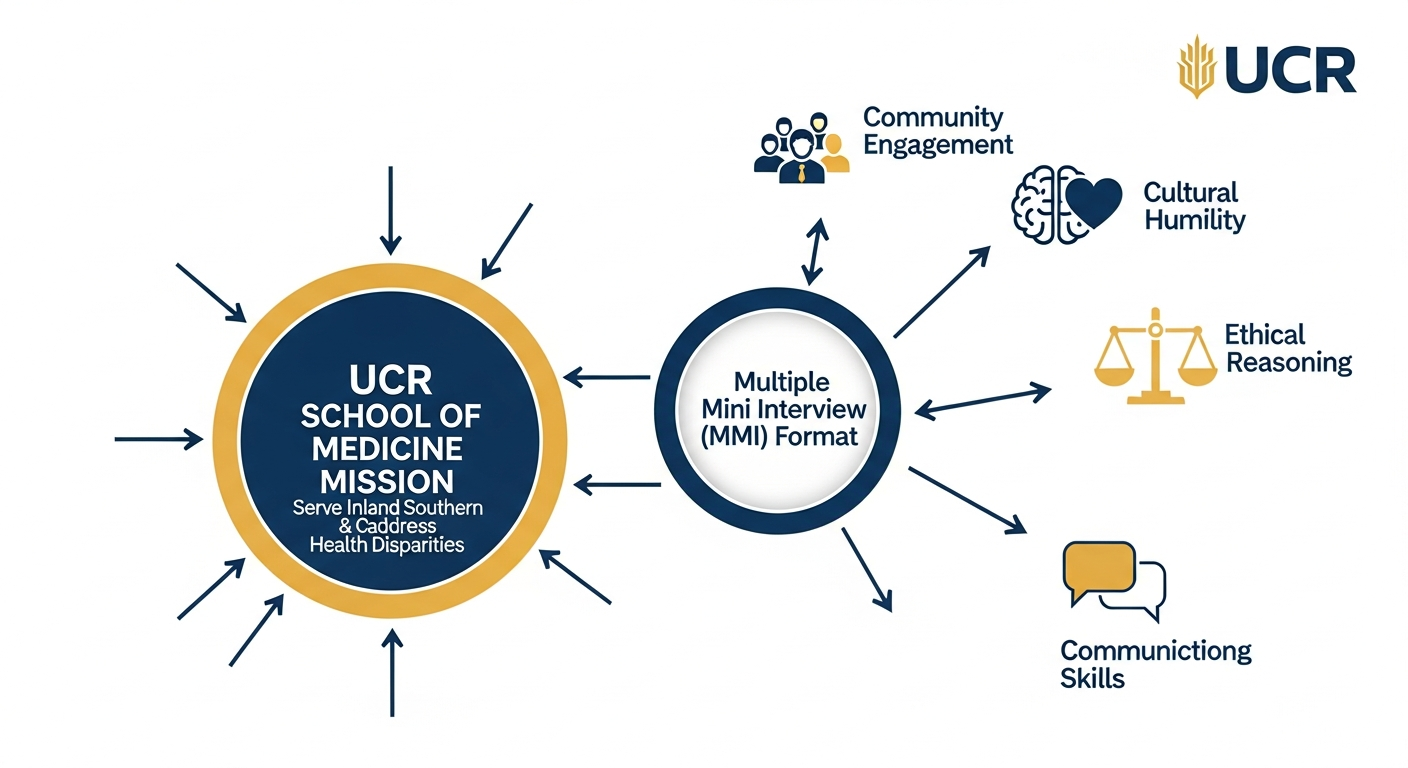
by Cracking Med School Admissions
The UCR MMI format is a direct reflection of its mission, designed to identify candidates with the specific qualities needed to serve the community.
The UCR School of Medicine interview process is distinguished by its direct and unwavering connection to its mission. While many schools assess general competencies, UCR is specifically looking for future physicians dedicated to community engagement, addressing health disparities, and practicing with cultural humility. The interview format, a Multiple Mini Interview (MMI), is designed to evaluate these attributes through practical, scenario-based questions that test your critical thinking, ethical reasoning, and communication skills in contexts relevant to the challenges faced in the region.
Beyond the Application: What This Guide Will Cover
This guide moves beyond generic interview advice to provide a comprehensive roadmap tailored specifically for the UCR School of Medicine interview. We will delve into the school’s core identity, deconstruct the MMI format, offer strategic preparation techniques, and provide frameworks for crafting impactful responses. By the end of this article, you will have a clear understanding of what UCR is looking for and how to present your most authentic, mission-aligned self.
download your interview guide
If you are prepared, the interview gives you the perfect opportunity to standout and shine by sharing with people what you are passionate about.

Understanding UCR School of Medicine's Core Identity and Mission
To excel in your UCR interview, you must first deeply understand the institution’s DNA. Every question you answer and every interaction you have should be filtered through the lens of UCR’s foundational principles.
UCR SOM Mission and Vision: What Interviewers Are Looking For
The mission is clear: “to improve the health of the people of California and, especially, to serve Inland Southern California by training a diverse workforce of physicians and by developing innovative research and health care delivery programs that will improve the health of the medically underserved in the region and become models to be emulated throughout the state and nation.” Interviewers are looking for evidence that you have not only read this statement but have internalized it. They want to see applicants whose past experiences and future goals resonate with this commitment to community-based health and service to underserved populations.
Key Values to Embody: Grit, Integrity, Resilience, and Innovation
UCR values future physicians who demonstrate core personal attributes essential for tackling complex health challenges. Be prepared to share experiences that showcase:
- Grit and Resilience: How have you overcome a significant academic or personal challenge? Medicine is a demanding path, and UCR wants to see that you have the tenacity to persevere.
- Integrity: Can you articulate a situation where you upheld a strong ethical principle, even when it was difficult? Trust is the bedrock of the patient-physician relationship.
- Innovation: How do you think about solving problems? UCR seeks creative thinkers who can contribute to new models of health care delivery.
The UCR Commitment to Inland Southern California and Medically Underserved Communities
This is arguably the most critical element to understand. You must demonstrate a genuine, well-researched interest in the Inland Southern California region. This goes beyond a surface-level statement. Research the specific health disparities in Riverside and San Bernardino counties. Understand the demographic makeup, including the large Latinx and immigrant populations. Be familiar with challenges like access to care, chronic disease prevalence, and environmental health factors. Articulating a clear understanding of these local issues is non-negotiable.
Embracing Diversity, Equity, and Inclusion (DEI initiatives) at UCR
UCR is committed to training a diverse physician workforce that mirrors the community it serves. The interview will likely assess your understanding of cultural humility and your ability to work effectively with patients from all backgrounds. Reflect on your own experiences with diversity and how they have shaped your perspective on medicine. Be prepared to discuss how you would contribute to an inclusive learning environment and provide equitable care to a diverse patient population.
Crafting Your Authentic “Why UCR?” Narrative
Your “Why UCR?” response must be specific and personal. Generic answers about sunny California or the reputation of the University of California system will fall flat. Connect your personal story—your experiences, values, and career aspirations—directly to UCR’s mission. Did you work in a community health clinic? Did you research health disparities? Have you lived or worked with underserved populations? Weave these concrete examples into a compelling narrative that explains why UCR is the only place for you.
The UC Riverside Medical School Interview Format: MMI Deep Dive
UCR utilizes the Multiple Mini Interview (MMI) format to provide a holistic assessment of its applicants. Understanding the structure and purpose of the MMI is the first step toward a successful performance.
What is the Multiple Mini Interview (MMI)?
The MMI is a series of short, independent interview stations, typically 6-8 in number. In each station, you will be presented with a scenario or question and given a short amount of time (usually 2 minutes) to prepare your response before entering a room (or virtual breakout room) to discuss it with an interviewer for a set period (around 5-8 minutes). This format is designed to evaluate core competencies like communication, ethical reasoning, critical thinking, and empathy, reducing the bias that can occur in a single, long traditional interview.
Anatomy of an MMI Station: Understanding Question and Scenario Types
MMI stations at UCR are designed to assess your alignment with their mission and values. You may encounter several types of prompts:
- Ethical Scenarios: Presenting a moral dilemma related to patient care, professionalism, or resource allocation.
- Situational Judgment: Asking how you would handle a difficult interpersonal situation with a colleague, supervisor, or patient.
- Policy/Advocacy Questions: Probing your awareness of current health care issues, particularly those affecting underserved communities in California.
- Personal/Behavioral Questions: These stations may feel more traditional, asking you to reflect on past experiences related to teamwork, leadership, or overcoming a challenge.
- Acting/Role-Playing Stations: You may be asked to interact with a standardized patient or confederate to assess your communication and empathy skills in real-time.
The Virtual Interview Landscape: Expectations for the Zoom Format
Given the prevalence of virtual interviews, it’s crucial to prepare your technical setup. Ensure you have a stable internet connection, good lighting, a high-quality webcam, and a quiet, professional background. Test your technology beforehand. During the interview, maintain eye contact by looking at the camera, not just the screen. Minimize distractions and treat the virtual format with the same level of professionalism as an in-person interview. The structure remains the same, with automated rotations between virtual breakout rooms for each station.
The Role of Interviewers and What They Assess
Your interviewers will be a mix of faculty, community physicians, medical students, and administrative staff. Each interviewer only assesses your performance in their specific station and is unaware of your performance in others. They are trained to evaluate specific competencies based on your response and interaction. They are not trying to trick you; they are trying to see how you think, communicate your reasoning, and demonstrate the personal qualities of a future UCR physician.
Strategic Interview Preparation: Beyond Generic Advice
Effective preparation for the UCR MMI involves targeted research, structured practice, and deep self-reflection.
Deconstructing MMI Scenarios: A Framework for Thoughtful Responses
For any scenario-based question, develop a consistent framework. A helpful approach is:
- Acknowledge and Identify: Clearly state the core issue or dilemma presented in the prompt.
- Gather Information: What do you know? What do you not know? Articulate what additional information you would seek before acting.
- Identify Stakeholders: Who is affected by this situation (the patient, family, colleagues, the institution, yourself)? Consider their perspectives.
- Outline Options & Consequences: Discuss potential courses of action, weighing the pros and cons of each.
- State Your Action & Justify: Choose the most ethical and reasonable course of action and provide a clear justification based on principles like patient autonomy, beneficence, and justice.
In-Depth Research on UCR School of Medicine:
Go beyond the mission statement on the homepage. Explore the UCR School of Medicine website thoroughly. Look into specific community partnerships (e.g., the street medicine program), research centers, student-run clinics, and curriculum details (like the Longitudinal Ambulatory Care Experience). Mentioning a specific program that aligns with your interests during your interview demonstrates genuine enthusiasm and diligent research.
Connecting Your Experiences to UCR’s Mission and Values
Review your entire application. For every significant activity, identify the core competency or value it demonstrates (e.g., leadership, resilience, commitment to service). Then, practice explicitly connecting that experience to UCR’s mission. For example, “My experience volunteering at a free clinic in a rural area taught me the importance of culturally competent care, which I know is a cornerstone of the UCR School of Medicine’s approach to serving the Inland Empire.”
Mastering Communication Skills: Verbal and Non-Verbal Cues
How you communicate is as important as what you communicate. Speak clearly and at a measured pace. It’s okay to pause and think before answering. Maintain an open and engaged posture. Use non-verbal cues like nodding to show you are listening. Your goal is to come across as thoughtful, articulate, and empathetic.
Practicing Effectively: Mock Interviews and Self-Reflection
Practice is essential. Time yourself responding to sample MMI prompts. Record yourself to analyze your pacing, body language, and clarity. If possible, participate in a mock MMI program offered by your university’s pre-health advising office. After each practice session, reflect on your response. Could you have been more concise? Did you consider all perspectives? This iterative process of practice and reflection is the key to building confidence.
Crafting Impactful Responses: Key Interview Themes
While MMI prompts vary, they often revolve around several core themes. Preparing for these will allow you to adapt to almost any question.
“Tell Me About Yourself”: Developing Your Strategic Personal Narrative
Even in an MMI, you may get a station with this classic question. Prepare a concise, compelling 90-second narrative that connects your past experiences to your present goal of attending UCR and your future aspirations as a physician. This is your “elevator pitch” and should be mission-focused.
Addressing “Why Medicine?” and “Why UCR?”: Beyond Surface-Level Answers
Your “Why Medicine?” should be a personal story, not a generic statement about wanting to help people. Ground it in a concrete experience. As discussed, your “Why UCR?” must be deeply specific, linking your unique skills and passions directly to the school’s mission, curriculum, and commitment to Inland Southern California.
Discussing Strengths, Weaknesses, and Learning from Challenges
When discussing strengths, choose qualities that align with UCR’s values (e.g., resilience, empathy) and provide a brief example. For weaknesses, choose a genuine area for growth, show self-awareness, and most importantly, describe the concrete steps you are taking to improve. When discussing a challenge, focus less on the problem and more on the process: what you did, what you learned, and how it made you a better future physician.
Navigating Ethical Dilemmas and Situational Judgment Questions
Use the framework mentioned earlier. Always remain non-judgmental and prioritize patient well-being and safety. Demonstrate your ability to see an issue from multiple perspectives. There is often no single “right” answer; the interviewers are assessing your thought process and your ability to articulate sound ethical reasoning.
Questions About Teamwork, Leadership, and Collaboration
Medicine is a team sport. Be prepared with specific examples of when you worked effectively in a team, handled conflict with a teammate, or took on a leadership role. Highlight your ability to listen, communicate respectfully, and contribute to a common goal, as this is essential for any medical student and physician.
Thought-Provoking Questions to Ask Your Interviewers
At the end of some stations or the interview day, you may have the opportunity to ask questions. This is a chance to show your engagement and curiosity. Avoid questions that can be easily answered on the website. Instead, ask thoughtful questions about the interviewer’s experience, such as, “What do you find to be the most rewarding aspect of being involved with the UCR student community?” or “How have you seen the school’s mission translate into the student experience?”
The Interview Day: Logistics, Environment, and Mindset
On the day of the interview, focus on being calm, present, and professional. Double-check your technology if the interview is virtual. Dress in professional business attire. Log in or arrive early. During the interview, listen carefully to each prompt. It is perfectly acceptable to take a moment to collect your thoughts before beginning your response. Remember that each station is a fresh start. If one doesn’t go as well as you’d hoped, take a deep breath and refocus for the next one. Your mindset should be one of confident, authentic engagement. You have earned this opportunity; now, show them who you are.c
Conclusion
The UC Riverside School of Medicine interview is a unique opportunity to demonstrate that you are more than just your metrics. It is a chance to show your passion for serving the underserved, your deep understanding of the health challenges in Inland Southern California, and your possession of the personal qualities necessary to become a compassionate and effective physician. By thoroughly researching the school’s mission, understanding the MMI format, and practicing how to connect your personal story to UCR’s core values, you can confidently navigate this critical step. Approach the day with authenticity and enthusiasm, ready to prove you are the right fit for this exceptional medical school and the community it is dedicated to serving.