Introduction: Your Gateway to UAB Heersink School of Medicine
The University of Alabama Medical School Interview is a monumental achievement. Receiving an interview invitation from the University of Alabama at Birmingham (UAB) Heersink School of Medicine signifies that your academic record, MCAT score, and experiences outlined in your AMCAS and Secondary Application have captured the attention of the Admissions Committee. However, this is where the real evaluation begins. The interview is your single most important opportunity to transform your application from a collection of statistics and statements into a compelling, three-dimensional narrative of a future physician. It’s your chance to demonstrate the personal qualities, communication skills, and genuine passion for medicine that cannot be quantified on paper.
University of Alabama Medical
School Interview Tips
Pre-Interview Guidance
The University of Alabama at Birmingham (UAB) Heersink School of Medicine is deeply mission-driven, with a primary focus on improving the health of Alabama residents. The admissions committee looks for applicants who are committed to serving diverse communities, strengthening healthcare access, and contributing to the well-being of populations across the state. Expect a traditional interview format that is conversational but highly reflective—your interviewers want to understand your connection to Alabama, your service mindset, and how your personal experiences have shaped your readiness for medical school.
UAB Medical School Interview Tip #1: Highlight your ties to Alabama and commitment to the state
UAB places a strong emphasis on training physicians who understand and want to serve Alabama communities. Whether or not you are from Alabama, be prepared to articulate why you care about the state’s health challenges and how your past experiences prepared you to serve its people. Discuss community health efforts, clinical experiences, or meaningful connections you’ve had with Alabama residents.
Example: “During my summer volunteering at a clinic in rural Alabama, I saw how limited access to transportation and preventive care affects chronic disease management. That experience strengthened my desire to train at UAB, where I can continue addressing these barriers through community-centered care.”
UAB Medical School Interview Tip #2: Come ready with strong stories that reflect your values
UAB interviewers value maturity, reflection, and self-awareness. Many of their secondary prompts ask for stories—about patient interactions, identity, community service, and experiences in Alabama. In your interview, bring these stories to life. Choose anecdotes that illustrate who you are: your compassion, resilience, cultural humility, and commitment to serving diverse populations.
Example: “One patient I assisted during my clinical experience in Birmingham struggled to afford medications. Helping him navigate a patient-assistance program taught me how socioeconomic barriers directly impact health outcomes—and reaffirmed my commitment to serving vulnerable populations.”
UAB Medical School Interview Tip #3: Show depth when discussing what you learned from experiences
The UAB admissions committee pays close attention to your reflections. When discussing community service or patient care experiences, do more than summarize what happened—explain how you grew. Highlight what you learned about healthcare disparities, communication, teamwork, or Alabama’s healthcare landscape.
Example: “Working at a mobile health fair in Montgomery taught me not only about local health disparities but also how trust-building is essential in underserved areas. That insight has shaped how I approach every patient interaction.”
UAB Medical School Interview Tip #4: Clarify your background and moves—especially if you’ve lived in multiple places
UAB often asks applicants to explain the difference between where they grew up and their current permanent address. Interviewers may explore this topic further to understand your geographic ties and personal background. Be transparent about where you come from and how your journey—whether in Alabama or elsewhere—has shaped your perspective on community, service, and healthcare.
Example: “Although I grew up in Georgia, visiting family in Huntsville throughout my childhood gave me a strong connection to Alabama. Seeing firsthand how healthcare access differs between rural and urban areas contributed to my interest in community medicine.”
UAB Medical School Interview Tip #5: Emphasize your community involvement and readiness to serve
Community health is central to UAB’s mission. During your interview, highlight your long-term engagement in service—whether tutoring, volunteering at health fairs, organizing food drives, or working with underserved patients. Show that these aren’t box-checking activities for you, but ongoing commitments that inform the type of physician you hope to become.
Example: “Leading a weekly literacy program for children in a low-income neighborhood helped me appreciate how social determinants like education affect long-term health. UAB’s focus on community partnerships aligns perfectly with the work I hope to continue.”
Sample University of Alabama Medical School Interview Questions & Themes
- Why UAB?
Connect your service experiences, interest in Alabama health disparities, and commitment to working with diverse communities. - Tell me about a meaningful patient interaction.
Choose a specific story—ideally one where you had a direct impact—and describe what you learned. - How have your identity and background shaped your values?
Discuss how your personal experiences influence your approach to working with individuals different from yourself. - Describe a community service experience and what you learned from it.
Focus on growth: communication skills, cultural humility, leadership, or understanding systemic barriers. - What ties do you have to Alabama?
Highlight geographic, family, educational, or service-related connections—or your motivation to serve the state.
Need Help With Your University of Alabama Medical School Interview?
Our team at Cracking Med School Admissions has extensive experience preparing applicants for UAB’s mission-driven interview process. We’ll help you refine your Alabama-focused narratives, strengthen your patient and community stories, and practice the reflective style UAB expects.
Contact us to start preparing today!
Your medical school application Coaches, Mentors, & Cheerleaders
We Personally Advise Every Student We Work With
Rachel Rizal, M.D.
Changing the trajectory of people's lives
Undergraduate
Princeton University
Medical School
Stanford School of Medicine
Residency
Harvard, Emergency Medicine
Awards & Scholarships
Fulbright Scholar
USA Today Academic First Team
Tylenol Scholarship
Rishi Mediratta, M.D., M.Sc., M.A.
Advising students to attend their dream schools
Undergraduate
Johns Hopkins University
Medical School
Stanford School of Medicine
Residency
Stanford, Pediatrics
Awards & Scholarships
Marshall Scholar
Tylenol Scholarship
Global Health Scholar
Each year, the Cracking Med School Admissions team
helps students get accepted to top medical schools.
We can help you get accepted!
Contact us today.
The Significance of the Interview at UAB
At the UAB Heersink School of Medicine, the interview is far more than a formality. It is a critical assessment of your suitability for the medical profession and your specific fit within the UAB community. The Admissions Committee seeks to understand your motivations, your ethical framework, your resilience, and your ability to connect with others. They are not just admitting a student; they are selecting a future colleague who will one day serve the people of Alabama and beyond.
Why UAB Heersink: A Unique Opportunity
Situated in the vibrant medical hub of Birmingham, the UAB Heersink School of Medicine is a powerhouse of clinical care, research, and medical education. It is an institution deeply committed to serving the diverse population of Alabama while pushing the boundaries of biomedical discovery. An interview here is an invitation to join a community dedicated to innovation, compassionate care, and health equity.
What This Guide Will Cover
This guide is designed to provide you with a comprehensive, strategic roadmap for your UAB medical school interview. We will delve into the school’s core values, dissect the interview format, provide frameworks for answering challenging questions, and offer practical advice for presenting your most authentic and capable self. Our goal is to equip you with the knowledge and confidence needed to excel.
download your interview guide
If you are prepared, the interview gives you the perfect opportunity to standout and shine by sharing with people what you are passionate about.
Understanding UAB Heersink's Mission and Values

by Cracking Med School Admissions
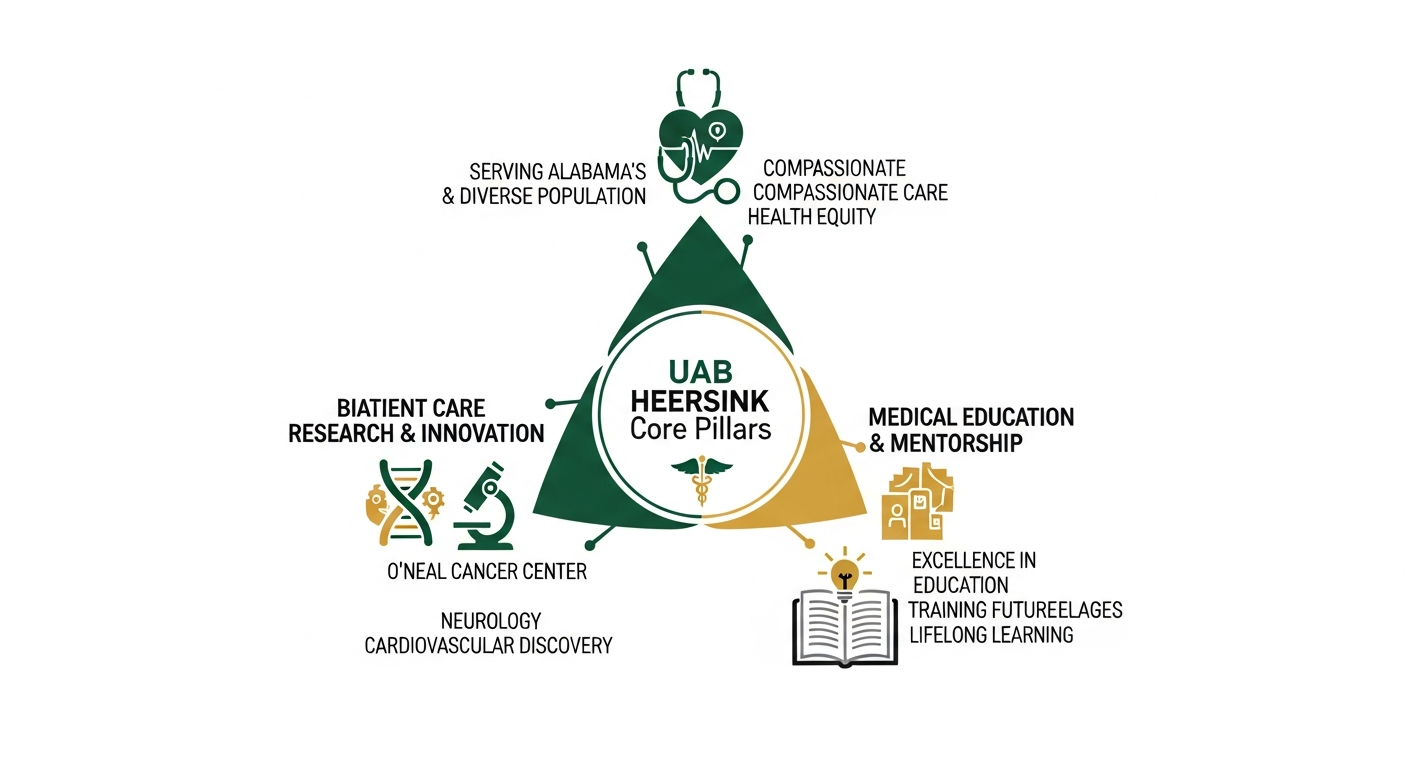
UAB Heersink’s mission is built on three interconnected pillars. Aligning your experiences with these areas is key to a successful interview.
To truly impress your interviewers, you must demonstrate a deep and genuine understanding of what makes the UAB Heersink School of Medicine unique. This goes beyond a superficial reading of the school’s website; it requires a thoughtful exploration of its mission and the qualities it prizes in each student.
Researching the UAB Heersink School of Medicine: Beyond the Website
Your research should be an active, investigative process. Start with the school’s mission statement, which emphasizes excellence in patient care, biomedical research, and education. Then, dig deeper. Look into specific research centers of excellence, such as the O’Neal Comprehensive Cancer Center or the institutes focused on neurology and cardiovascular diseases. Identify faculty members whose work aligns with your interests. Explore unique curriculum tracks, student organizations, and community outreach programs like the student-run Equal Access Birmingham clinic. This level of detailed research allows you to move from a generic “Why UAB?” response to a specific, compelling narrative about how your goals align with the school’s distinct opportunities.
Identifying Core Qualities UAB Seeks: Compassion, intellectual curiosity, resilience, leadership, communication skills
The Admissions Committee uses the interview to assess key attributes defined by the AAMC as core competencies for entering medical students. UAB Heersink places a high value on:
- Compassion: The ability to empathize with patients and understand their experiences.
- Intellectual Curiosity: A genuine drive to ask questions, seek knowledge, and contribute to medical science.
- Resilience: The capacity to navigate the rigors of medical training and the emotional challenges of patient care.
- Leadership: The potential to influence and improve healthcare systems, whether in a clinical or research setting.
- Communication Skills: The ability to listen actively and convey information clearly and empathetically to patients and colleagues.
During your preparation, reflect on specific moments in your life where you have demonstrated these qualities.
Decoding the UAB Medical School Interview Format
The UAB Heersink School of Medicine employs a hybrid interview format, combining traditional one-on-one interviews with the Multiple Mini Interview (MMI). This approach provides the Admissions Committee with a holistic view of each candidate, assessing both conversational fit and core competencies in standardized scenarios.
Preparing for the Multiple Mini Interview (MMI) Format
The MMI is a series of short, timed stations, each presenting a different scenario. These are not designed to test your scientific knowledge but rather your critical thinking, ethical reasoning, and interpersonal skills. Scenarios may involve acting with a standardized patient, discussing an ethical dilemma, or collaborating with a partner on a task. To prepare, practice thinking aloud and structuring your response logically. First, identify the core issue. Second, consider the perspectives of all involved parties. Third, outline your proposed course of action and provide a clear justification. The goal isn’t to find the one “right” answer but to demonstrate a thoughtful, mature, and methodical approach to problem-solving.
The Role of Traditional Interview Components (if applicable)
Alongside the MMI, you will likely have one or more traditional interviews. These are more conversational and allow interviewers to delve into your application in greater detail. Be aware that interviewers may have varying levels of familiarity with your file—some may have read it thoroughly, while others may have only seen your name. Be prepared to summarize your journey, articulate your motivations, and elaborate on key experiences from your AMCAS application, Secondary Application, and Letters of Recommendation without assuming prior knowledge.
Navigating Virtual Interviews with Confidence
Currently, many interviews are conducted virtually. While the format is different, the core principles remain the same. Ensure your technology is flawless, your environment is professional and free of distractions, and your lighting and audio are clear. Practice making eye contact with the camera, not just the screen, to create a more direct and personal connection with your interviewers.
Strategic Preparation: Laying the Foundation for Success
Effective interview preparation is not about memorizing answers; it’s about deep self-reflection and developing the ability to articulate your story in a clear and compelling way.
Deep Self-Reflection: Knowing Your Story Inside Out
Before you practice a single question, take time to reflect on your journey. Why medicine? What specific moments solidified this path? What was your most meaningful clinical experience, research project, or volunteer activity, and what did you learn from it? How have you grown from your challenges and failures? Your ability to tell authentic stories that connect your past experiences to your future aspirations as a physician is the cornerstone of a successful interview. Your personal statement and Secondary Application are excellent starting points for this reflection.
Practicing Effectively: Beyond Just Answering Questions
Practice should focus on process, not just content. Record yourself answering common questions to assess your pacing, tone, and body language. Participate in mock interviews with advisors, mentors, or peers. The key is to solicit honest feedback on the clarity of your response and the logical flow of your reasoning. Practice articulating your thought process for MMI-style ethical questions. This helps you build the confidence to think on your feet and deliver a structured response under pressure.
Mastering Common UAB Interview Questions
While every interview is unique, certain themes and question types appear consistently. Preparing thoughtful responses to these questions will provide a strong foundation for your interview day.
Behavioral Interview Questions: “Tell me about a time…”
These questions are designed to see how you have acted in past situations. The best way to answer them is using the STAR method:
- Situation: Briefly describe the context.
- Task: Explain your specific role or goal.
- Action: Detail the steps you took.
- Result: Conclude with the outcome and, most importantly, what you learned from the experience. This structure ensures your response is concise, detailed, and focused on your personal contribution.
Ethical Dilemma and Situational Questions
These MMI-style questions assess your judgment and understanding of professional responsibilities. You may be asked about patient confidentiality, conflicts of interest, or resource allocation. Approach these by acknowledging the complexity of the situation, identifying the competing ethical principles (e.g., autonomy vs. beneficence), and explaining your reasoning for a particular course of action. Show that you can see multiple viewpoints before reaching a balanced conclusion.
Questions About Your Background and Experiences
Be prepared to discuss any aspect of your application in detail, from a specific research project to a volunteer role you held. The goal for the interviewer is to understand your role, your contribution, and what you gained from the experience. This is your opportunity to bring your application to life with personal anecdotes and reflections.
“Why UAB?” and “Why Medicine?” Questions
These are arguably the two most important questions you will face. Your “Why Medicine?” answer should be a personal narrative, not a generic statement. Your “Why UAB?” response must be highly specific. Connect your personal interests and career goals directly to unique programs, research opportunities, faculty, or community initiatives at the UAB Heersink School of Medicine.
Asking Insightful Questions to Your Interviewers
At the end of the interview, you will be invited to ask questions. This is not a mere formality. It is a chance to demonstrate your intellectual curiosity and genuine interest. Prepare thoughtful questions about the student experience, campus culture, research opportunities, or the interviewer’s own journey at UAB. Avoid asking questions whose answers are easily found on the school’s website.
Showcasing Your Fit: UAB, Alabama, and Beyond
A successful interview involves demonstrating not only that you are qualified for medical school, but that you are a perfect fit for the UAB Heersink School of Medicine specifically.
Connecting Your Experiences to UAB’s Unique Offerings
Draw explicit lines between your background and what UAB offers. If you have a passion for serving rural communities, discuss how you hope to get involved with UAB’s primary care track or rural medicine programs. If your research focused on oncology, express your excitement about the possibility of contributing to the O’Neal Comprehensive Cancer Center.
Demonstrating Knowledge of Alabama’s Healthcare Landscape
UAB is the flagship medical institution for the state of Alabama. Showing an awareness of the state’s specific healthcare challenges and disparities—such as high rates of diabetes, hypertension, and rural health access issues—demonstrates a mature understanding of the community you would be serving as a student and future physician.
Leveraging Your Alabama Connections (if applicable)
If you have ties to Alabama, whether through family, previous education, or work, be sure to mention them. This can strengthen your case for wanting to study and potentially practice in the state, which is a key consideration for a state medical school.
Excelling in the Virtual Interview Environment
Mastering the virtual format is crucial for making a strong impression. Success depends on careful preparation before and during the interview.
Pre-Interview Preparation: Setting the Stage for Success
Test your technology—internet connection, camera, and microphone—multiple times before interview day. Choose a location that is quiet, well-lit, and has a professional, uncluttered background. Dress in full professional attire, just as you would for an in-person interview. Have a copy of your application, your resume, and your prepared questions ready for reference.
During the Virtual Interview: Maximizing Your Presence
Engage actively with your interviewers. Maintain eye contact by looking at your webcam, nod to show you are listening, and use positive, open body language. Speak clearly and at a measured pace. It is crucial to minimize distractions; close unnecessary tabs on your computer and inform anyone you live with of your interview schedule to ensure you are not interrupted.
Post-Interview Etiquette and Follow-Up
Your professionalism should extend beyond the interview itself. Thoughtful follow-up can reinforce the positive impression you made.
Sending Thoughtful Thank-You Notes
Within 24-48 hours, send a personalized thank-you note or email to each of your interviewers. In your message, briefly reiterate your interest in the UAB Heersink School of Medicine and reference a specific point from your conversation. This demonstrates that you were engaged and valued the discussion. Keep the note concise and professional. This final touch is a mark of courtesy that can leave a lasting positive impact on the Admissions Committee.
Your interview at the UAB Heersink School of Medicine is the culmination of years of hard work. By preparing thoughtfully, reflecting deeply on your journey, and communicating your passion with authenticity, you can confidently demonstrate that you have what it takes to become an outstanding physician and a valuable member of the UAB community.