The Ultimate Guide to Acing Your University of Utah Medical School Interview

The University of Utah Medical School Interview is a monumental achievement in your application journey. In an incredibly competitive landscape where the school receives over 5,000 applications for just 125 spots, this invitation signals that the Admissions Committee sees immense potential in your profile. For the 2025 entering class, this translates to an acceptance rate of about 2.5%, making every subsequent step critical. Your AMCAS Application, MCAT score, and Secondary Application have brought you this far; the interview is your final, most personal opportunity to demonstrate why you are an ideal fit for their community of future physicians. This guide will provide a comprehensive roadmap to help you navigate the process and present the most authentic, compelling version of yourself on interview day.

University of Utah Medical School Interview Tips

Pre-Interview Guidance

The University of Utah School of Medicine is committed to training future physicians who will serve the people of Utah—particularly rural and underserved communities. The school values community engagement, cultural humility, academic excellence, and applicants who demonstrate genuine interest in improving healthcare access throughout the state.

Most applicants can expect a traditional or panel-style interview format, though the tone is conversational. Interviewers want to understand your motivations for medicine, your alignment with the Utah mission, and your potential fit for pathways such as RUUTE (Rural & Underserved Utah Training Experience). Think of the interview as your chance to connect your lived experiences, service work, and values to the university’s mission.

University of Utah Medical School Interview Tip #1: Be clear and compelling about “Why University of Utah”

Just like the secondary’s first question, your interviewers will expect a personalized and well-researched answer about why you’re excited to join Utah’s community. Avoid generic responses like “I like the curriculum” or “I enjoy the outdoors.” Instead, tie Utah-specific programs, values, and pathways to your past experiences and future goals.

Example: If you’ve been involved in mobile health clinics, you can emphasize how Utah’s community-driven curriculum and partnerships with underserved areas align with your desire to continue delivering accessible care.

University of Utah Medical School Interview Tip #2: Tell meaningful stories from your clinical or community experiences

One of the strongest ways to stand out—both in the secondary and in the interview—is by sharing personal stories. Utah interviewers appreciate applicants who can reflect deeply on patient interactions, volunteer work, and hands-on service. Your stories should demonstrate empathy, resilience, teamwork, and commitment to improving patient care.

Example: Instead of simply stating that you volunteered at a free clinic, describe a specific patient encounter, what you learned about listening and cultural humility, and how the experience strengthened your commitment to compassionate care.

University of Utah Medical School Interview Tip #3: Highlight your interest in rural or underserved medicine (especially for RUUTE)

The RUUTE program is a major part of the University of Utah’s mission. Even if you’re not applying directly to RUUTE, showing an understanding of rural health challenges and underserved communities will resonate with interviewers. If you are interested in RUUTE, be ready to speak authentically about experiences in rural settings, or your motivation to serve rural Utah in the future.

Example: You might share a story about shadowing in a rural clinic where limited access to specialists required creative problem-solving and strong physician-patient relationships. Then connect this to how you hope to train in communities similar to those served by RUUTE.

University of Utah Medical School Interview Tip #4: If you are a reapplicant, be ready to discuss your growth

Utah values self-reflection and continuous improvement. Reapplicants must thoughtfully explain what they learned from the previous cycle, how they strengthened their application, and what new clinical, service, or academic experiences shaped their path—especially those completed in Utah.

Example: You might explain how you realized you lacked longitudinal patient exposure, so over the past year you worked as a medical assistant, developed stronger communication skills, and gained deeper insight into patient needs.

University of Utah Medical School Interview Tip #5: Reflect maturity and professionalism in every answer

Interviewers often ask questions designed to reveal your judgment, character, and ability to succeed in a collaborative medical environment. Show that you can handle adversity, navigate ethical situations, and communicate respectfully—key values at Utah.

Example: If asked about a time you faced conflict on a team, describe how you initiated an open conversation, sought understanding, and prioritized your shared goal—in a way that mirrors the collaboration expected in clinical settings.

Sample University of Utah Medical School Interview Questions & Themes
  • Why University of Utah?
    Highlight programs, values, or pathways (such as RUUTE or community partnerships) that align with your goals.
  • Tell me about a meaningful patient or community experience.
    Share a story that demonstrates empathy, reflection, and your motivation to serve diverse populations.
  • What interests you about rural or underserved medicine?
    Connect your past experiences—or your future aspirations—to Utah’s mission to serve these communities.
  • How have you improved your application since last cycle?
    For reapplicants, offer detailed reflections, growth, and new experiences—especially those in Utah.
  • Describe an ethical dilemma or professionalism challenge you faced.
    Show integrity, accountability, and a patient-first mindset.
Need Help With Your University of Utah Medical School Interview?

Our team at Cracking Med School Admissions has helped applicants succeed in University of Utah interviews for years. Through mock interviews, we’ll help you sharpen your “Why Utah” answer, refine your rural medicine stories, and practice professionalism and scenario-based questions so you can walk into your interview confident and prepared.

Contact us to start your preparation today!

Your medical school application Coaches, Mentors, & Cheerleaders

We Personally Advise Every Student We Work With

Dr. Rachel Rizal

Rachel Rizal, M.D.

Changing the trajectory of people's lives

Undergraduate
Princeton University

Medical School
Stanford School of Medicine

Residency
Harvard, Emergency Medicine

Awards & Scholarships
Fulbright Scholar
USA Today Academic First Team
Tylenol Scholarship

Rishi Mediratta, MD, MSc, MA

Rishi Mediratta, M.D., M.Sc., M.A.

Advising students to attend their dream schools

Undergraduate
Johns Hopkins University

Medical School
Stanford School of Medicine

Residency
Stanford, Pediatrics

Awards & Scholarships
Marshall Scholar
Tylenol Scholarship
Global Health Scholar

Each year, the Cracking Med School Admissions team
helps students get accepted to top medical schools.
We can help you get accepted!

Contact us today.

download your interview guide

If you are prepared, the interview gives you the perfect opportunity to standout and shine by sharing with people what you are passionate about.

Med School Admissions Interview Guide eBook Cover
  • This field is for validation purposes and should be left unchanged.

The Pivotal Role of Your University of Utah Medical School Interview

Why the Interview is Your Most Important Opportunity

The medical school interview serves a purpose that metrics and essays cannot: it humanizes your application. While your MCAT score and GPA showcase your academic capability, the interview is where the Admissions Committee assesses the personal qualities essential for a successful career in medicine—empathy, communication, resilience, and ethical reasoning. It’s your chance to articulate your motivation, connect your experiences into a coherent narrative, and demonstrate a genuine understanding of and alignment with the University of Utah’s unique mission. This is where you transform from a set of statistics into a future colleague.

What the University of Utah (SFESOM) Evaluators Seek

The Spencer Fox Eccles School of Medicine (SFESOM) Admissions Committee is looking for more than just future doctors; they are seeking future leaders, innovators, and compassionate caregivers who will serve the diverse communities of Utah and the Intermountain West. They evaluate applicants on a range of competencies, including your motivation for medicine, capacity for teamwork and leadership, communication skills, and understanding of the social and ethical contexts of healthcare. They want to see evidence of your commitment to service, your intellectual curiosity through research or other scholarly activities, and your personal maturity in handling challenges.

Understanding the University of Utah's Interview Format and Expectations

The Common Interview Formats at SFESOM

The University of Utah typically utilizes a traditional, one-on-one interview format. Applicants usually have two separate interviews with members of the admissions committee, which may include faculty, community physicians, and sometimes senior medical students. These interviews are often “semi-blind” or “closed-file,” meaning the interviewer may only have access to your personal statement and experiences from your AMCAS Application, but not your grades or MCAT score. This format places a strong emphasis on your ability to articulate your journey and personal qualities without relying on academic metrics.

Logistics of Interview Day: Virtual vs. In-Person

In recent application cycles, SFESOM has predominantly used a virtual format for interviews. A virtual interview day typically includes the two one-on-one interviews, an orientation session, a virtual tour, and opportunities to interact with current students. Whether virtual or in-person, professionalism is paramount. For virtual interviews, ensure you have a stable internet connection, a quiet and professional background, and appropriate lighting. Test your technology beforehand to prevent any last-minute issues. Treat the entire event with the same seriousness as you would an in-person visit.

Deep Dive into SFESOM's Mission: Tailoring Your Responses for Fit

Aligning with the Mission-Driven MD Program

SFESOM’s mission is centered on advancing health through compassionate care, discovery, and education, with a strong focus on the health of the community in Utah and the surrounding region. To align your responses, you must go beyond generic statements about wanting to help people. Connect your personal experiences to this specific mission. Discuss how your volunteer work in a local clinic reflects a commitment to community health or how your research project aligns with the school’s spirit of discovery. Show that you have thoroughly researched the curriculum, faculty, and unique programs at the University of Utah and can articulate exactly how you will contribute to and benefit from this specific environment.

Showcasing Interest in Rural & Underserved Communities (RUUTE)

A cornerstone of the University of Utah’s commitment to the state is the Rural & Underserved Utah Training Experience (RUUTE) program. This program places students in clinical rotations across Utah, providing critical healthcare to rural and underserved populations. The Admissions Committee values applicants who demonstrate a genuine interest in this area. If you have experience or a stated desire to work in such settings, your interview is the perfect place to highlight it. Discuss what draws you to rural medicine, what you have learned from any relevant experiences, and how you see yourself contributing to programs like RUUTE. This demonstrates a clear understanding of and commitment to one of the school’s most important initiatives.

Strategic Preparation: Mastering Common and SFESOM-Specific Question Types

Crafting Compelling Behavioral Responses (Storytelling)

Many interview questions will be behavioral, asking you to provide specific examples of how you have handled situations in the past (e.g., “Tell me about a time you worked on a team”). The most effective way to answer these is by using the STAR method:

  • Situation: Briefly describe the context.
  • Task: Explain your specific role or goal.
  • Action: Detail the steps you took.
  • Result: Summarize the outcome and, most importantly, what you learned from the experience.

This storytelling framework transforms a simple answer into a compelling narrative that showcases your skills in leadership, teamwork, or problem-solving.

Navigating Ethical Dilemmas and Situational Judgment

You may be presented with a hypothetical ethical scenario to gauge your thought process and moral reasoning. There is often no single “right” answer. The interviewers are interested in how you think, not what you think. When faced with such a question, remain calm. Acknowledge the complexity of the situation, identify the competing ethical principles (e.g., autonomy vs. beneficence), consider the perspectives of all involved parties, and articulate a reasoned, balanced approach to resolving the dilemma.

The “Why Medicine?” and “Why University of Utah?” Questions

These two questions are virtually guaranteed. Your answer to “Why Medicine?” should be a personal, reflective narrative that combines your intellectual curiosity for science with your motivation to serve others. For “Why University of Utah?”, be specific. Move beyond general praise. Reference specific faculty, research opportunities, community clinics, or curriculum elements like RUUTE that genuinely excite you. This demonstrates that your interest is not superficial but is based on thorough research and a real desire to be part of that specific academic community. The strength of the primary care program, once ranked 14th in the nation by Business Insider, could be a key point of interest for some applicants.
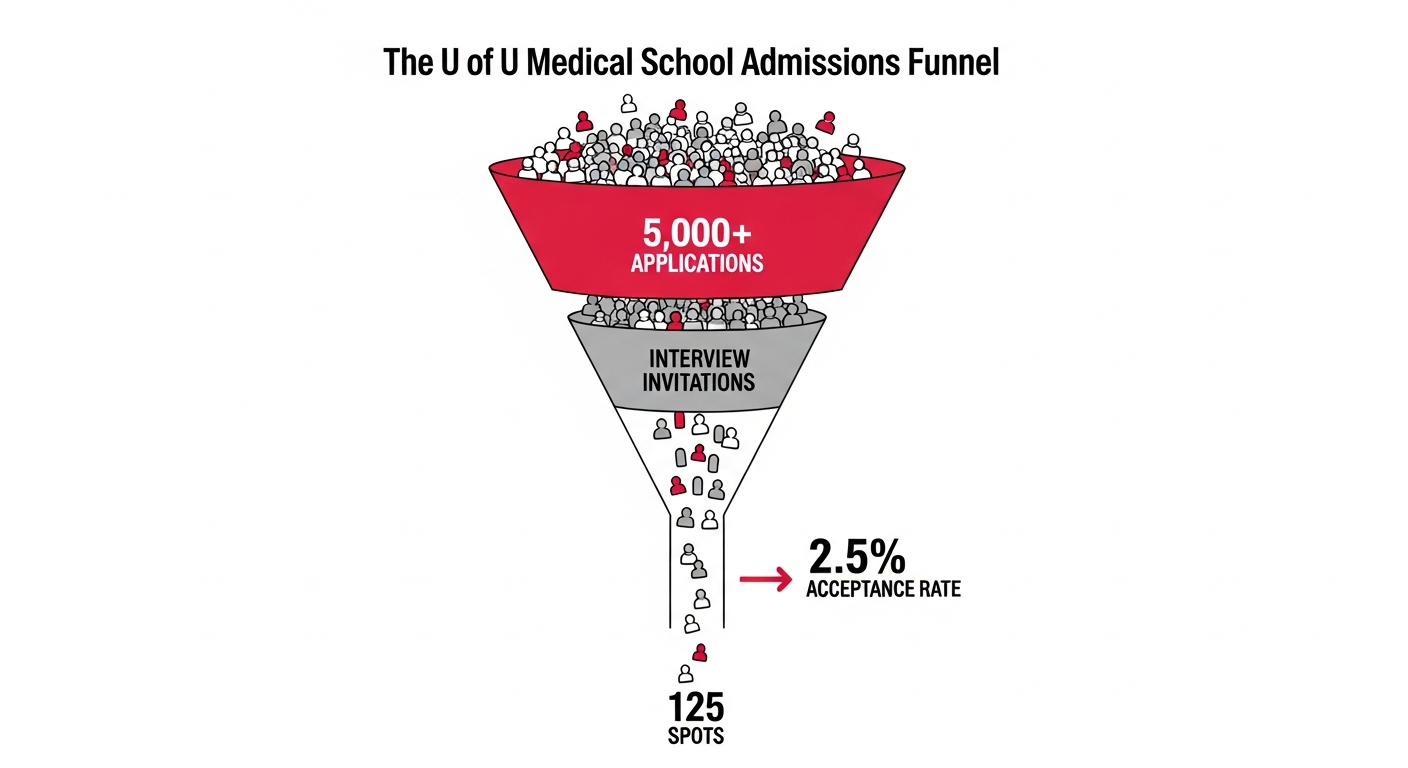
University of Utah Medical School Interview Tips by Cracking Med School Admissions


The admissions funnel for the University of Utah School of Medicine highlights the selectivity of the process, with over 5,000 applicants vying for 125 positions.

Addressing Challenging Scenarios

Be prepared to discuss weaknesses or challenges from your application. Whether it’s a lower-than-expected grade, a gap in your experiences, or a withdrawn course, the key is to be honest and demonstrate growth. Frame the experience as a learning opportunity. Explain the circumstances without making excuses, detail the steps you took to improve or overcome the challenge, and articulate what you learned about yourself in the process. This turns a potential negative into a positive demonstration of self-awareness and resilience.

Honing Your Interview Skills: Practice Makes Perfect

The Invaluable Role of Mock Interview Sessions

There is no substitute for live practice. Mock interviews with pre-health advisors, mentors, or peers are essential for refining your answers and building confidence. These sessions help you identify verbal tics, practice your timing, and receive constructive feedback on the content and delivery of your responses. The goal isn’t to memorize scripts but to become comfortable articulating your thoughts and experiences clearly and concisely under pressure.

Refining Communication and Professionalism

Your communication skills are under a microscope during the interview. Practice active listening, making sure you fully understand the question before you answer. Maintain professional body language—good posture, appropriate eye contact (even through a camera), and engaged listening. Speak clearly and confidently. Professionalism extends beyond the interview itself to every interaction you have with the school, from emails with the admissions staff to conversations with current students.

Thorough Research and Question Preparation

Effective preparation involves more than just practicing answers. Re-read your entire AMCAS and Secondary Application to refresh your memory of every detail. Research the University of Utah School of Medicine extensively—its curriculum, faculty research interests, student organizations, and community partnerships. Finally, prepare a list of thoughtful questions to ask your interviewers. Asking insightful questions about their experience at the school or the future direction of a program demonstrates genuine engagement and intellectual curiosity.

Post-Interview Etiquette and Navigating the Admissions Cycle

Thoughtful Follow-Up: The Power of Thank-You Notes

Sending a thank-you note after your interview is a professional courtesy that reinforces your interest in the program. An email is perfectly acceptable and timely. Personalize each note to the interviewers you met, referencing a specific point from your conversation. Keep it concise, professional, and express your genuine appreciation for their time. This small gesture can leave a lasting positive impression.

Understanding the Admissions Timeline and Next Steps

After the interview, the waiting period begins. The University of Utah, like most medical schools, has a specific timeline for releasing decisions. Familiarize yourself with this timeline to manage your expectations. While you wait, it is generally best to avoid contacting the admissions office unless you have a significant update to your application (e.g., a new publication or major award). Continue to focus on your current studies or activities.

Preparing for Potential Acceptance

While the interview is a significant hurdle, national data shows that approximately 40-45% of all medical school applicants get accepted after the interview, indicating your chances improve dramatically once you reach this stage. If you receive an offer of acceptance, celebrate your incredible achievement! Read the acceptance materials carefully to understand the deadlines for decisions and any financial aid requirements. Being prepared for this outcome will allow you to make a thoughtful and timely decision about your future career.

Final Resources and Encouragement

Recommended Resources

To further your preparation, consult official resources from SFESOM’s admissions website, which often provides the most accurate and up-to-date information. The AAMC (Association of American Medical Colleges) also offers valuable resources on interview preparation and medical school admissions. Engaging with current students through official school events can also provide invaluable, firsthand reviews and insights.

Your Journey to the Medical Profession

The journey to becoming a physician is a marathon, and the interview for the University of Utah School of Medicine is a critical leg of the race. Trust in the hard work that has brought you to this point. Prepare diligently, be authentic, and communicate your unique story and passion for medicine. You have earned this opportunity, and you are ready to show the Admissions Committee the outstanding physician you will become.

Conclusion

Acing your University of Utah School of Medicine interview is about more than just having the right answers; it’s about demonstrating authentic alignment with the school’s mission, showcasing your unique personal qualities, and articulating a compelling vision for your future career in medicine. By understanding the interview format, deeply researching the school’s values—particularly its commitment to research and community health in Utah—and strategically preparing your responses, you can present yourself as an exceptional candidate. Practice through mock interviews, refine your communication, and approach interview day with confidence. Remember to follow up professionally and navigate the remainder of the application cycle with patience. Your interview is the culmination of your hard work, a chance to connect on a human level, and the final step toward earning a place among the next generation of physicians at the University of Utah.

Get in!

Ask Us a Question. We help Students just like you
Get Into University of Utah Medical School Every Year!

Contact Page
Scroll to Top