

The University of Missouri-Columbia Medical School Interview marks a monumental milestone at the end of a long journey to medical school. After conquering the MCAT and meticulously crafting your AMCAS application, receiving an interview invitation from the University of Missouri-Columbia School of Medicine is a significant achievement. While approximately 44% of MD applicants matriculated in the last cycle, the interview is the final, pivotal step that separates qualified applicants from future physicians. It is your single best opportunity to transcend the data points on your application and demonstrate the human qualities—empathy, resilience, and passion—that define a great doctor.
The University of Missouri-Columbia Medical School Interview is the focus of this comprehensive guide, which provides a strategic roadmap tailored specifically to the Mizzou interview process. We will delve into the school’s unique philosophy, deconstruct the interview format, and offer actionable strategies to help you articulate your story, showcase your alignment with their mission, and confidently present your best self to the admissions committee.
University of Missouri-Columbia Medical
School Interview Tips
Pre-Interview Guidance
The University of Missouri – Columbia School of Medicine (Mizzou Med) seeks applicants who are service-driven, collaborative, and committed to caring for the diverse populations of Missouri. The school places strong emphasis on community engagement, inclusive learning environments, and hands-on patient care beginning early in training. Your interview—typically in a traditional, conversational format—is your opportunity to highlight how your values align with Mizzou’s mission while demonstrating maturity, reflection, and readiness for medical school. Expect questions that explore your experiences, your motivations, and how you will contribute to the Mizzou community.
University of Missouri – Columbia Medical School Interview Tip #1: Share any authentic Missouri or Mizzou connections
Whether you’ve lived in Missouri, volunteered in the state, completed research at Mizzou, or have family in Columbia, these connections matter. Interviewers want to see genuine familiarity with the region and an understanding of the communities the school serves. If you do not have direct ties, you can still speak to what draws you to Missouri’s patient populations and training environments.
Example: “During my summer volunteering at Barnes-Jewish Hospital, I learned how social support varies across Missouri communities. Seeing this firsthand reinforced my commitment to training in a state where I can contribute meaningfully to patient education and community health.”
University of Missouri – Columbia Medical School Interview Tip #2: Discuss diversity in terms of your strengths, activities, and life experiences
Mizzou defines diversity broadly. You don’t need an ethnic or cultural identity story to stand out—your diverse perspectives, leadership experiences, and passions are equally valuable. Use your interview to highlight how your background equips you to collaborate with peers and serve patients from a range of life circumstances.
Example: “As captain of my university’s soccer team, I learned how to bring together teammates with different communication styles and strengths. Those experiences taught me how to create an inclusive environment—skills I will carry into team-based clinical settings at Mizzou.”
University of Missouri – Columbia Medical School Interview Tip #3: Demonstrate your commitment to inclusivity with a concrete story
Mizzou takes pride in creating a welcoming, student-centered learning environment. Expect questions about how you will contribute to an inclusive community or how you’ve done so in the past. Avoid broad, theoretical statements; instead, choose a specific moment that reflects how you build trust and belonging.
Example: “While serving as a Camp Kesem counselor, I organized small-group activities so quieter children could feel comfortable sharing. Seeing them open up over the summer showed me the impact of intentionally designing inclusive spaces—something I aim to bring to my Mizzou peer groups and patient interactions.”
University of Missouri – Columbia Medical School Interview Tip #4: If you’re a re-applicant, show thoughtful reflection and meaningful growth
Re-applicants must demonstrate awareness of past weaknesses and clear evidence of improvement. Mizzou interviewers respond well to applicants who can articulate how they’ve strengthened their clinical exposure, patient care experiences, volunteering, or connection to Missouri communities. Humility paired with progress goes a long way.
Example: “After reflecting on my previous cycle, I realized my clinical exposure was limited. Over the past year, I worked as a patient care tech in a rural Missouri clinic, where I learned to support patients navigating chronic conditions and insurance challenges. Those experiences deepened my motivation to serve in Missouri long-term.”
University of Missouri – Columbia Medical School Interview Tip #5: Communicate how your experiences align with Mizzou’s service-focused mission
Mizzou values students who will serve the people of Missouri through compassionate, community-centered care. Throughout your interview, connect your past experiences—clinical, service-based, or leadership—to the school’s mission and training opportunities. Highlight the ways you hope to grow through Mizzou’s clinical rotations, community partnerships, and emphasis on patient-centered medicine.
Example: “My work coordinating diabetes education workshops taught me how to meet patients where they are. I’m excited about Mizzou’s longitudinal patient exposure because it will let me continue developing long-term relationships grounded in trust and education.”
Sample University of Missouri – Columbia Medical School Interview Questions & Themes
Why Mizzou Med?
Show specific ties to Missouri communities, Mizzou’s mission, or clinical opportunities that match your goals.
How will you contribute to an inclusive learning environment?
Share a concrete story demonstrating empathy, team-building, or creating belonging.
Tell me about how your background adds diversity to the class.
Focus on strengths, leadership, experiences, or perspectives—not just cultural identity.
What have you done to strengthen your application if you’re a re-applicant?
Be honest, reflective, and specific about improved clinical exposure, volunteering, or Missouri engagement.
How have your experiences prepared you to serve Missouri’s diverse patient populations?
Connect patient interactions, service work, or community engagement to Mizzou’s mission.
Need Help With Your University of Missouri – Columbia Medical School Interview?
Our Cracking Med School Admissions team has coached countless applicants through successful Mizzou interviews. We’ll help you refine your stories, strengthen your “Why Mizzou” answer, and practice inclusive-environment scenarios so you walk into interview day confident and prepared.
Contact us to start your personalized mock interview coaching today.
Your medical school application Coaches, Mentors, & Cheerleaders
We Personally Advise Every Student We Work With

Rachel Rizal, M.D.
Changing the trajectory of people's lives
Undergraduate
Princeton University
Medical School
Stanford School of Medicine
Residency
Harvard, Emergency Medicine
Awards & Scholarships
Fulbright Scholar
USA Today Academic First Team
Tylenol Scholarship

Rishi Mediratta, M.D., M.Sc., M.A.
Advising students to attend their dream schools
Undergraduate
Johns Hopkins University
Medical School
Stanford School of Medicine
Residency
Stanford, Pediatrics
Awards & Scholarships
Marshall Scholar
Tylenol Scholarship
Global Health Scholar
Each year, the Cracking Med School Admissions team
helps students get accepted to top medical schools.
We can help you get accepted!
Contact us today.
download your interview guide
If you are prepared, the interview gives you the perfect opportunity to standout and shine by sharing with people what you are passionate about.

The Pivotal Role of Your Mizzou Interview
Why the Interview is Your Opportunity to Shine
Your application file—comprising your GPA, MCAT score, research, and healthcare experiences—has already proven your academic and experiential qualifications. The interview serves a different, more profound purpose: it assesses your personal traits and determines your fit within the Mizzou community. The admissions committee wants to know who you are beyond the paper. Are you a compassionate communicator? Can you think critically under pressure? Do you possess the maturity and self-awareness required for a demanding medical career? This is your chance to connect your life experiences to your motivation for medicine and demonstrate the intangible qualities that your transcript cannot convey.
Understanding Mizzou’s Admissions Philosophy: Beyond the Numbers
 University of Missouri Columbia Medical School Interview Tips
by Cracking Med School Admissions
Mizzou’s admissions philosophy centers on finding future physicians who align with its mission to serve the diverse communities of Missouri.
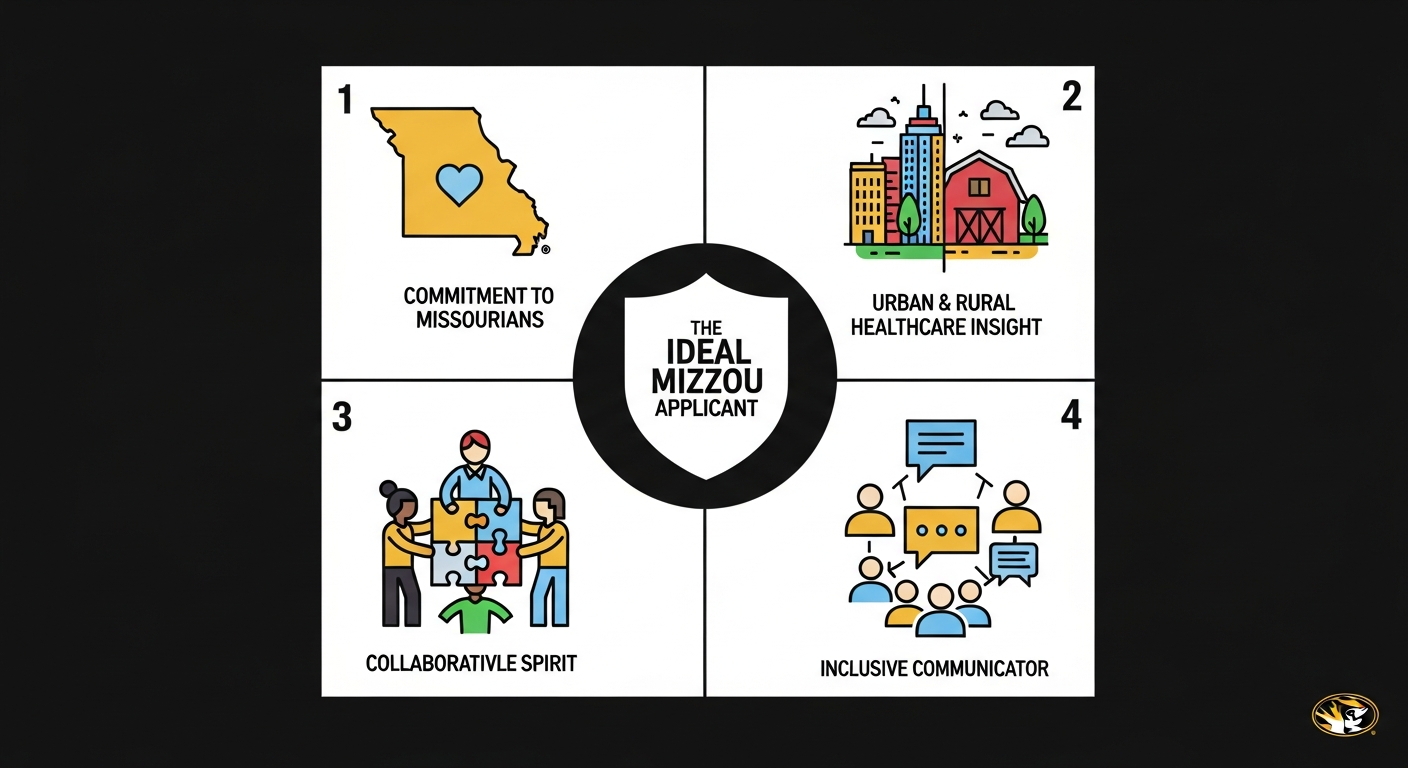
The University of Missouri School of Medicine is deeply committed to its role as a state institution. Its mission is to improve the health of all people, especially Missourians. This is not just a slogan; it is the core of their admissions philosophy. They seek candidates who demonstrate a genuine interest in serving the community, an understanding of the challenges facing healthcare in both urban and rural settings, and the collaborative spirit necessary for their patient-based learning curriculum. They are looking for future colleagues who will contribute positively to their inclusive learning environment and uphold the values of the institution.
Decoding the University of Missouri-Columbia School of Medicine
Mizzou’s Mission, Vision, and Core Values
Before your interview, you must internalize Mizzou’s mission: “to advance the health of all people, especially Missourians, through exemplary education, research, and patient-centered care.” This mission is built on core values of excellence, respect, service, integrity, and responsibility. In your interview, every answer should, in some way, reflect these principles. When discussing your volunteering experiences, frame them through the lens of service. When describing a team project, highlight respect and responsibility. Your ability to connect your personal journey to Mizzou’s institutional goals is paramount.
Key Programs and Opportunities to Highlight
Demonstrating genuine interest requires more than a surface-level review of the school’s website. You must identify specific programs that resonate with your career aspirations. Are you interested in Mizzou’s pioneering Patient-Based Learning (PBL) curriculum? Be prepared to discuss why this small-group, case-based approach appeals to your learning style. Are you drawn to the Rural Scholars Program or the summer research opportunities? Articulate how these unique offerings align with your past experiences and future goals. Mentioning specific faculty research or community partnerships shows you’ve done your homework and envision yourself thriving at the University of Missouri.
Articulating Your “Why Mizzou?” Effectively
The “Why our school?” question is inevitable and critically important. A generic answer is a missed opportunity. Your response must be a compelling synthesis of your personal mission and Mizzou’s institutional identity. Structure your answer by connecting three key points:
- The Curriculum: Explain how the PBL model or other specific educational features will make you a better physician.
- The Mission: Connect your own experiences in Missouri (if applicable) or your commitment to community health with Mizzou’s focus on serving the state.
- The Opportunities: Reference a specific research area, student organization, or clinical opportunity that excites you and explain how you plan to contribute.
Navigating the Mizzou Interview Process: What to Expect
The Application and Interview Timeline
Typically, after submitting your AMCAS application and Mizzou’s secondary application, interview invitations are sent out on a rolling basis from late summer through early spring. The interview season generally runs from September to March. It is crucial to respond promptly to any communication and schedule your interview as soon as you are able. A timely response demonstrates professionalism and continued interest in the program.
Deconstructing Mizzou’s Hybrid Interview Format
Mizzou traditionally uses a hybrid interview format that includes multiple components to assess candidates holistically. This may involve one-on-one interviews with faculty members, administrators, or current medical students. These conversations are designed to be conversational but probing, allowing interviewers to delve into your AMCAS application, explore your motivations, and assess your interpersonal skills. You may also encounter scenario-based questions that test your critical thinking and ethical reasoning. The goal is to get a multi-faceted view of you as a candidate.
Logistics of Your Interview Day
Whether your interview is virtual or in-person, preparation is key. For virtual interviews, test your technology—camera, microphone, and internet connection—well in advance. Choose a quiet, professional, and well-lit location. For in-person interviews, plan your travel to Columbia, Missouri, arriving with ample time to avoid stress. The day often includes an orientation, a financial aid session, a tour of the facilities, and opportunities to speak with current students. Treat every interaction, from the welcome session to informal conversations, as part of the interview.
Mastering Common Interview Question Categories
Tell Me About Yourself: Crafting Your Compelling Narrative
This open-ended prompt is your invitation to frame your candidacy. Avoid simply listing your resume. Instead, craft a concise, 1-2 minute narrative that connects your key experiences to your decision to pursue medicine at Mizzou. Start with a grounding statement about who you are, touch on a pivotal experience (research, clinical, or personal) that solidified your commitment, and end by linking your journey to your future goals at the University of Missouri School of Medicine.
Behavioral Questions: Demonstrating Core Competencies (STAR Method)
Behavioral questions (“Tell me about a time when…”) are designed to evaluate past performance as a predictor of future behavior. The STAR method is an essential tool for structuring your answers:
- Situation: Briefly describe the context.
- Task: Explain your specific goal or responsibility.
- Action: Detail the concrete steps you took to address the situation. This should be the longest part of your answer.
- Result: Conclude with the outcome and, most importantly, what you learned from the experience.
Prepare examples that highlight competencies like teamwork, leadership, problem-solving, and resilience, drawing directly from your application.
Ethical Scenarios and Healthcare Insights
You may be presented with a hypothetical ethical dilemma or asked about a current issue in healthcare. Interviewers are not looking for a single “correct” answer. They want to see your thought process. Acknowledge the complexity of the issue, consider multiple perspectives (patient, physician, family, hospital), discuss the ethical principles at play (e.g., autonomy, beneficence), and articulate a reasoned, compassionate course of action. Showing awareness of the challenges facing medicine, such as the projected shortage of up to 86,000 physicians by 2036, demonstrates your engagement with the profession.
“Why Medicine?” and “Why Mizzou?”: Deepening Your Commitment
These foundational questions require deep self-reflection. Your “Why Medicine?” answer should be a personal story, not a generic statement about helping people. What specific direct patient care or shadowing experiences exposed you to the realities of medicine and solidified your resolve? For “Why Mizzou?”, as discussed earlier, your answer must be specific, well-researched, and connect your personal aspirations directly to what the University of Missouri-Columbia School of Medicine offers.
Leveraging Your Application History and Experiences
Transforming Your Primary and Secondary Applications into Interview Stories
Your AMCAS application and secondary essays are the script; the interview is your performance. Review them thoroughly. Be prepared to elaborate on any experience you listed, from a research project to a volunteer position. Don’t just repeat what you wrote. Add depth and reflection. What did you learn about yourself? How did that shadowing experience change your perspective on patient care? Use your written application as a launching point for richer, more detailed stories that showcase your growth.
Addressing Your Application History: The Reapplicant’s Guide
If you are a reapplicant, be prepared to discuss it openly and positively. Frame it as a period of growth and strengthening. Clearly articulate what you have done since your last application to improve your candidacy. Did you gain more direct patient care experience? Retake the MCAT? Engage in new research? Mizzou’s admissions committee values resilience and commitment. Showing you took feedback, identified areas for improvement, and took concrete steps to become a stronger applicant is a sign of maturity.
Showcasing Diversity and Unique Perspectives
Diversity extends beyond race and ethnicity to include your unique life experiences, background, and perspective. Think about what makes your journey unique. Mizzou is committed to creating an inclusive learning environment and wants to know how you will contribute. Discuss how your background has shaped your understanding of others and prepared you to care for a diverse patient population. It is important to note the ongoing efforts to maintain diversity in medicine, especially as some data shows a recent decline in the number of Black students who identified as incoming MD students. Your unique perspective is a valuable asset.
Strategic Pre-Interview Preparation
In-Depth Research on Mizzou School of Medicine
Go beyond the mission statement. Explore the curriculum guide, read recent news releases from the medical school, and identify faculty whose work interests you. Familiarize yourself with student life and community outreach programs. The more specific your knowledge, the more authentic your interest will appear.
Practice Makes Perfect: Mock Interviews and Self-Reflection
Practice answering common questions out loud. Record yourself to assess your pacing, body language, and clarity. Arrange mock interviews with pre-health advisors, mentors, or peers. The goal is not to memorize answers but to become comfortable articulating your thoughts. After each practice session, reflect on what went well and what could be improved.
Preparing Your Interview Environment and Technology
For a virtual interview, your environment is part of your professional presentation. Ensure you have a stable internet connection and good lighting. Your background should be neutral and free of distractions. Do a full tech rehearsal the day before to avoid last-minute glitches.
Mental Preparation and Mindset
The day before your interview, put away your notes. Your preparation is done. Focus on getting a good night’s sleep and eating a healthy meal. On interview day, approach the experience with confidence and curiosity. Remember, it’s a two-way street. You are also evaluating if Mizzou is the right fit for you.
Performing Your Best During the Interview
Active Listening and Thoughtful Responses
Listen carefully to the entire question before formulating your response. It is perfectly acceptable to take a brief pause to gather your thoughts. This shows you are being deliberate, not that you are unprepared. Engage with your interviewer’s questions and, if appropriate, ask for clarification to ensure you are providing the information they seek.
Clarity, Conciseness, and Structure in Your Answers
Structure your answers logically, especially for behavioral questions using the STAR method. Avoid rambling. Aim for responses that are thorough yet concise, typically around two minutes. A well-structured answer is easier for your interviewer to follow and demonstrates clear thinking.
Demonstrating Professionalism and Engagement
From your attire to your communication, professionalism is key. Maintain eye contact, sit up straight, and convey enthusiasm and energy. Engage in the conversation, ask thoughtful questions about the program and student life, and show genuine interest in your interviewers and their roles at Mizzou.
Conclusion
Your interview at the University of Missouri-Columbia School of Medicine is the culmination of your hard work and the definitive opportunity to prove you belong. By deeply understanding Mizzou’s mission, strategically preparing to articulate your journey, and engaging with authenticity and professionalism, you can transform this high-stakes event into a genuine conversation. Remember to connect your experiences—from research and shadowing to your unique personal traits—to the core values of the institution. Prepare diligently, trust in your journey, and let your passion for medicine and commitment to serving others shine through. This is your moment to show the admissions committee the remarkable physician you will become.