The University of Toledo Medical School Interview is a monumental achievement. Receiving an interview invitation from the University of Toledo College of Medicine and Life Sciences signifies that the admissions committee sees promise in your application and is ready to learn about the person behind the metrics. In a landscape where total medical school enrollment has reached over 99,000 students, securing this opportunity is a critical step. However, the interview is more than just a final hurdle; it’s your prime opportunity to demonstrate alignment with UToledo’s unique mission and prove you have the non-cognitive skills essential for a career in medicine.
The University of Toledo Medical School Interview is the focus of this comprehensive guide, which provides a clear roadmap to navigate every stage of the process. We move beyond generic advice to offer targeted strategies that address the specific values, curriculum, and culture of the College of Medicine and Life Sciences, empowering you to present your most compelling and authentic self.
University of Toledo Medical School Interview Tips
Pre-Interview Guidance
The University of Toledo College of Medicine and Life Sciences is known for training physicians who are service-oriented, resilient, and deeply committed to caring for diverse patient populations—especially across Ohio. Your interview is an opportunity to show how your values align with Toledo’s mission, your readiness for their patient-centered curriculum, and your ability to thrive in a collaborative learning environment. Expect a traditional interview format that is conversational but intentional, with questions aimed at understanding your personal qualities, problem-solving skills, and how you will contribute to the Toledo community.
University of Toledo Medical School Interview Tip #1: Highlight meaningful experiences with diverse populations
Several of Toledo’s secondary prompts emphasize working with individuals from backgrounds different from your own. In the interview, expect questions that explore your cultural humility, communication skills, and ability to serve a diverse patient base. Go beyond general statements about valuing diversity—come ready with a specific story that demonstrates your impact and personal growth. Interviewers want to understand how these experiences will shape the way you serve patients in Ohio.
Example: Instead of saying “I value diversity,” describe a moment when you helped a patient or community member whose cultural background influenced their health needs, what you learned from that interaction, and how you plan to apply those lessons when caring for Toledo’s diverse communities.
University of Toledo Medical School Interview Tip #2: Prepare a strong resilience and adaptability story
Toledo asks applicants to reflect on resilience in the secondary application, and this theme often appears again in the interview. Avoid generic academic examples like a poor test grade or an MCAT setback—these rarely distinguish you. Instead, choose a moment outside the classroom where you demonstrated persistence, adaptability, and emotional maturity under stress. Toledo values applicants who can handle demanding clinical environments with composure.
Example: You might discuss adjusting to a new caregiving role in your family, navigating a challenging community project, or overcoming obstacles during a clinical job—highlighting what you learned and how it strengthened your commitment to medicine.
University of Toledo Medical School Interview Tip #3: Discuss insights from the COVID-19 pandemic thoughtfully
The secondary application dedicates an entire prompt to COVID-19 reflections, so interviewers may revisit this topic. They want to understand what you learned, how you served others, and how the experience shaped your perspective on healthcare. If you did COVID-related work in Ohio or gained insight into Ohio’s health needs, be sure to tie that in—it demonstrates a genuine connection to the region and its patient population.
Example: You might share how volunteering at an Ohio testing site taught you about disparities in access to care, and how this motivates you to train in a school committed to regional health improvement.
University of Toledo Medical School Interview Tip #4: Show intentionality behind your gap-year or post-graduation activities
Toledo asks directly about how you’ve spent your time between undergrad and medical school. In your interview, be prepared to elaborate on those experiences—especially how they prepared you for medical school. Aim for a balanced mix of clinical, service, and non-clinical activities. If you engaged in meaningful work in Ohio, highlight it to show regional commitment.
Example: If you worked as a medical assistant, describe a moment that deepened your understanding of patient care and how the experience reinforced your desire to study medicine in Ohio.
University of Toledo Medical School Interview Tip #5: Be ready to explain why Toledo is the right fit for you
Just like the secondary, the interviewers will want to know why you are genuinely drawn to the University of Toledo. Your answer should be specific—mention aspects such as clinical opportunities in Northwest Ohio, service initiatives that align with your background, or Toledo’s focus on training adaptable, community-minded physicians.
Example: If you have experience serving Midwestern communities, you can emphasize how Toledo’s emphasis on regional health and community engagement aligns with your long-term goals of practicing in Ohio.
Sample University of Toledo Medical School Interview Questions & Themes
- Tell me about your experience working with individuals from backgrounds different from your own.
Share a specific story that illustrates empathy, communication, and cultural humility. - Describe a time you demonstrated resilience.
Avoid academic setbacks; choose a more distinctive example that showcases adaptability. - What did you learn from the COVID-19 pandemic?
Discuss personal growth, service experiences, or insights into Ohio’s health landscape. - How have you spent your time since graduating?
Connect your activities to the competencies needed for success in medical school. - Why the University of Toledo?
Give program-specific reasons and tie them to your goals, values, or prior work in Ohio.
Need Help With Your University of Toledo Medical School Interview?
Our team at Cracking Med School Admissions offers mock interview prep tailored specifically for the University of Toledo. We’ll help you strengthen your stories, polish your delivery, and prepare for mission-aligned questions so you can stand out.
Contact us to start preparing today!
Your medical school application Coaches, Mentors, & Cheerleaders
We Personally Advise Every Student We Work With
Rachel Rizal, M.D.
Changing the trajectory of people's lives
Undergraduate
Princeton University
Medical School
Stanford School of Medicine
Residency
Harvard, Emergency Medicine
Awards & Scholarships
Fulbright Scholar
USA Today Academic First Team
Tylenol Scholarship
Rishi Mediratta, M.D., M.Sc., M.A.
Advising students to attend their dream schools
Undergraduate
Johns Hopkins University
Medical School
Stanford School of Medicine
Residency
Stanford, Pediatrics
Awards & Scholarships
Marshall Scholar
Tylenol Scholarship
Global Health Scholar
Each year, the Cracking Med School Admissions team
helps students get accepted to top medical schools.
We can help you get accepted!
Contact us today.
download your interview guide
If you are prepared, the interview gives you the perfect opportunity to standout and shine by sharing with people what you are passionate about.
Laying the Foundation: Why the University of Toledo College of Medicine and Life Sciences?
understand what sets the institution apart. The admissions committee is not just looking for bright students; they are searching for future physicians who will contribute to their community and embody their core principles. A successful interview performance starts with a solid foundation of knowledge about the school itself.
Understanding UToledo’s Distinctive Mission and Values
The University of Toledo College of Medicine and Life Sciences places a profound emphasis on improving health in the communities it serves, particularly within Ohio. This commitment is not just a line in a mission statement; it’s a guiding principle that informs their educational philosophy and clinical training. Key values to recognize include a dedication to patient-centered care, pioneering research, and fostering a collaborative learning environment. The admissions committee wants to see evidence that your personal mission aligns with theirs. They are looking for candidates who demonstrate empathy, a commitment to service, and a genuine interest in addressing the healthcare needs of diverse populations.
Exploring UToledo’s Curriculum and Pedagogical Approach

by Cracking Med School Admissions
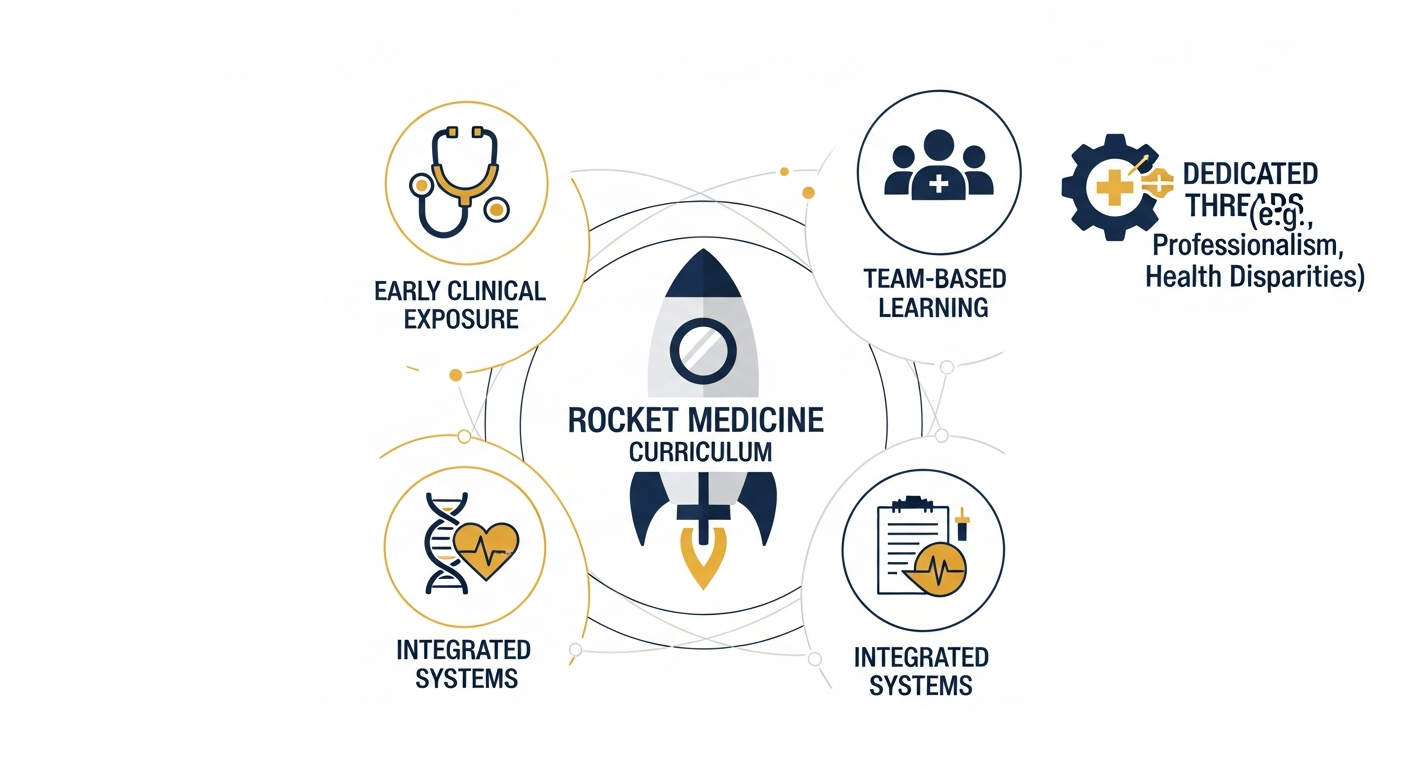
The ‘Rocket Medicine’ curriculum is built on four key pillars that integrate clinical skills with foundational science from day one.
Familiarize yourself with the specifics of UToledo’s curriculum. The “Rocket Medicine” curriculum is designed to be integrated, student-centered, and clinically relevant from the start. Note key features such as early clinical exposure, the use of team-based learning, and dedicated threads covering topics like professionalism and health disparities. Understanding these elements allows you to connect your learning style and past experiences to their specific educational model. For instance, if you have experience in collaborative projects, you can directly relate that to their emphasis on team-based learning, showing you are prepared to thrive in their system.
Clinical Opportunities and Research Landscape
UToledo offers a rich array of clinical experiences at the University of Toledo Medical Center and affiliated hospitals. Researching these sites and the patient populations they serve in Toledo provides you with specific points to discuss. Furthermore, the school has notable research strengths. Identify departments or specific faculty research that genuinely interests you. Being able to intelligently discuss a professor’s work or a unique clinical program demonstrates a level of interest that goes far beyond a surface-level review of their website. This shows you have envisioned yourself as an active member of their medical school class.
Navigating the UToledo Interview Process: What to Expect
Once you receive the invitation email, your focus shifts to the logistics and format of the interview day. Understanding the structure will help demystify the process, reduce anxiety, and allow you to concentrate on delivering your best performance.
Deciphering the Interview Format: Multiple Mini Interviews (MMI), Traditional, or Hybrid?
Medical schools utilize various interview formats, and it’s critical to know what UToledo currently employs. Historically, many schools have transitioned to the Multiple Mini-Interview (MMI) format, which assesses soft skills through a series of short, timed stations. Other schools may use traditional one-on-one interviews or a hybrid model. Carefully review all communications from the admissions office, as the format will be clearly stated in your interview invitation emails. If it’s an MMI, practice responding to ethical scenarios and policy questions under time constraints. If it’s traditional, prepare for a more in-depth conversation about your application and motivations.
Understanding the Admissions Committee’s Perspective
The admissions committee is composed of faculty, physicians, and sometimes current medical students. Their goal is to conduct a holistic review, looking for attributes that don’t appear on a transcript. They want to assess your communication skills, empathy, critical thinking, resilience, and understanding of the realities of a medical career. They are trying to answer one fundamental question: “Will this candidate be a successful medical student at our institution and a compassionate physician our future patients can trust?” Every interaction you have is part of this assessment.
Logistics of Interview Day: Virtual vs. Potential In-Person Experience
Whether your interview is virtual or in-person, meticulous preparation is key. For virtual interviews, test your technology—camera, microphone, and internet connection—well in advance. Ensure you have a quiet, professional, and well-lit space free from distractions. For in-person interviews, plan your travel to Toledo, arrange professional attire, and review any campus maps or schedules provided. The day often includes more than just the interview itself, such as a welcome from the dean, a curriculum overview, financial aid sessions, and opportunities to speak with current medical students. Engage fully in all activities; your level of interest is being observed throughout the day.
Strategic Pre-Interview Preparation: Beyond Generic Advice
Effective preparation is about introspection and targeted research, not memorizing scripted answers. This phase is where you build the content that will form the substance of your interview responses.
Deep-Dive Research: Know UToledo Inside and Out
Go beyond the homepage. Read articles from the UToledo Health News, explore the websites of specific departments or student organizations that interest you, and identify unique programs like community clinics or global health initiatives. This detailed knowledge will allow you to ask insightful questions and tailor your answers with specific examples, demonstrating a genuine and well-researched interest in becoming a part of their specific medical community.
Self-Reflection and Storytelling: Honing Your Narrative
Your AAMC application tells the “what” of your journey; the interview is your chance to explain the “why” and “how.” Re-read your entire application, including your personal statement and secondary essays. For each significant experience (clinical, research, volunteering, leadership), reflect on what you learned, how you grew, and how it solidified your desire for a career in medicine. Practice articulating these reflections concisely. Develop a collection of stories that illustrate key attributes like teamwork, problem-solving, and empathy.
Crafting Your Compelling “Why UToledo” Narrative
This is arguably the most important question you will face. A compelling answer synthesizes your personal goals with the school’s specific offerings. A strong narrative might follow this structure:
- Identify a specific feature of UToledo: Mention a unique curriculum element, research opportunity, community outreach program, or aspect of their mission.
- Connect it to your experience: Link this feature to a past experience or a future aspiration.
- Synthesize: Explain how this synergy makes UToledo the ideal place for you to develop into the physician you want to be.
Mock Interviews: Practice Makes Perfect
Practice is essential for refining your stories and managing your nerves. Ask your university’s pre-health advising office, mentors, or trusted peers to conduct a mock interview. Record yourself to identify and correct nervous habits like fidgeting or using filler words. The goal isn’t to create robotic answers but to become so comfortable with your own stories and motivations that you can communicate them clearly and confidently under pressure.
Mastering Common Interview Question Categories with UToledo in Mind
While you can’t predict every question, you can prepare for common categories. Tailoring your responses to reflect UToledo’s values will set you apart.
Behavioral Questions: Show, Don’t Just Tell (Using the STAR Method)
Behavioral questions ask you to provide specific examples of how you have handled situations in the past. The STAR method is an effective framework for structuring your answers:
- Situation: Briefly describe the context.
- Task: Explain your specific role or goal.
- Action: Detail the steps you took.
- Result: Conclude with the outcome and, most importantly, what you learned.
Prepare examples demonstrating teamwork, leadership, conflict resolution, and overcoming challenges.
Ethical Scenarios and Problem-Solving Questions
These questions assess your thought process, not a “correct” answer. Interviewers want to see that you can identify key ethical principles (e.g., autonomy, beneficence, justice), consider multiple perspectives, and articulate a reasoned approach. Walk them through your thinking step-by-step. Acknowledge the complexity of the situation and show that you can think critically and compassionately.
“Why Medicine?” and “Why UToledo?” Questions
Your “Why Medicine?” answer should be a personal narrative that combines your intellectual curiosity for science with a demonstrated passion for serving others. Your “Why UToledo?” answer must be specific, drawing on the deep-dive research you conducted. Avoid generic praise and instead focus on concrete aspects of the College of Medicine and Life Sciences that resonate with your career goals.
Diversity, Equity, and Inclusion (DEI) Questions
Medicine requires physicians who can care for patients from all backgrounds. Be prepared to discuss your understanding of health disparities and the importance of cultural competence. Reflect on experiences that have expanded your own perspective and demonstrate a commitment to providing equitable care to all future patients.
Current Events and Healthcare Policy Questions
You are expected to have a working knowledge of major issues facing the U.S. healthcare system. This could include topics like the physician shortage, healthcare costs, or the integration of technology. For example, with about 66% of physicians using some form of AI, you should be able to discuss the potential benefits and challenges of such advancements. You don’t need to be an expert, but you should be able to discuss a topic thoughtfully and demonstrate your engagement with the broader world of medicine.
Acing Interview Day: Presentation, Engagement, and Follow-Through
Your preparation culminates on interview day. How you present yourself and interact with everyone you meet contributes to the overall impression you make.
Professionalism and First Impressions (Virtual and In-Person)
Professionalism is non-negotiable. Dress in business attire. For virtual interviews, ensure your background is clean and professional. Whether online or in person, your conduct should be courteous and respectful to everyone, from the admissions coordinator to the faculty interviewer. First impressions are formed quickly, so begin with a confident smile, a firm handshake (if in-person), and direct eye contact.
Engaging Effectively with Interviewers and Faculty Members
The interview should be a conversation, not an interrogation. Listen actively to the questions being asked. It’s okay to take a moment to think before you speak. When you answer, be enthusiastic and genuine. At the end of the interview, ask the thoughtful questions you prepared. This demonstrates your engagement and genuine curiosity about the program, the curriculum, and the experience of their medical students.
Managing Nerves and Projecting Confidence
It’s natural to be nervous. Channel that energy into focus. Practice deep breathing exercises before the interview begins. Sit up straight and maintain an open posture. Remember that you were invited because the admissions committee already believes you are a strong candidate. Your task is simply to affirm their initial assessment.
Post-Interview Strategies: Reinforcing Your Candidacy
The interview may be over, but your engagement with the admissions process is not. Thoughtful follow-up can reinforce your interest and leave a lasting positive impression.
The Thoughtful Thank You Note: More Than Just a Courtesy
Send a personalized thank-you email to each of your interviewers within 24-48 hours. In your note, briefly reiterate your strong interest in the University of Toledo. More importantly, reference a specific point of your conversation. This shows you were actively listening and makes your note more memorable than a generic template. Keep the emails concise and professional.
Demonstrating Continued Interest (Letters of Intent/Interest)
If UToledo remains your top choice after all your interviews, a letter of intent can be a powerful tool. This letter should be sent later in the application cycle, reaffirming your commitment to matriculate if accepted. A letter of interest is less binding but still serves to update the admissions committee on any significant new accomplishments and restate your enthusiasm for their program.
Preparing for the Admissions Decision and Beyond
The waiting period is challenging. Stay patient and avoid excessive speculation on online forums. Use this time to continue your other activities and prepare for potential outcomes. Whether you receive an acceptance, a waitlist spot, or a rejection, handle the news with grace and professionalism. The medical school application process is a marathon, and your conduct at every stage matters.
Conclusion
A successful interview at the University of Toledo College of Medicine and Life Sciences is the product of thorough preparation, genuine self-reflection, and authentic enthusiasm. By deeply understanding the school’s mission to serve Ohio, familiarizing yourself with its innovative curriculum, and preparing to share your personal journey, you can demonstrate that you are more than just a collection of high MCAT scores and grades. You are a future physician ready to contribute to their vibrant medical community. Approach your interview not as a test, but as a conversation—an opportunity to connect with your future colleagues and mentors. With thoughtful preparation and confidence in your story, you can show the admissions committee exactly why you are an excellent fit for the next class of medical students at the University of Toledo.